
Ideas
Self-Care Habits: 50 Small Ideas and How to Make Them Stick
50 self-care habits for body, mind and the people around you, the research behind the ones that matter most, and how to choose three you’ll keep.
Self-care habits are the small, ordinary things you do regularly to look after your body, your mind and your relationships: a steady bedtime, a walk outside, a message to a friend. They don’t need to cost money or take an afternoon. The ones that help most are usually the dullest, done often.
Below are 50 self-care ideas grouped by area, the research behind the handful that matter most, and a simple way to pick your first three so they actually stick.
What makes a good self-care habit
Most lists of self-care ideas mix two different things: treats and habits. A spa day is a treat. Going to bed at the same time every night is a habit. Treats are lovely, but habits do the steady work, because they happen whether or not you feel like it.
A good self-care habit passes three tests:
- It’s small. “Stretch for 5 minutes” beats “do more yoga”.
- It’s specific. At the end of the day, you can say yes or no.
- It has a cue. “After I brush my teeth at night…” gives the habit a place in your day.
Use those tests as you read the list. If an idea fails one of them, shrink it or attach it to something you already do.
Types of self-care
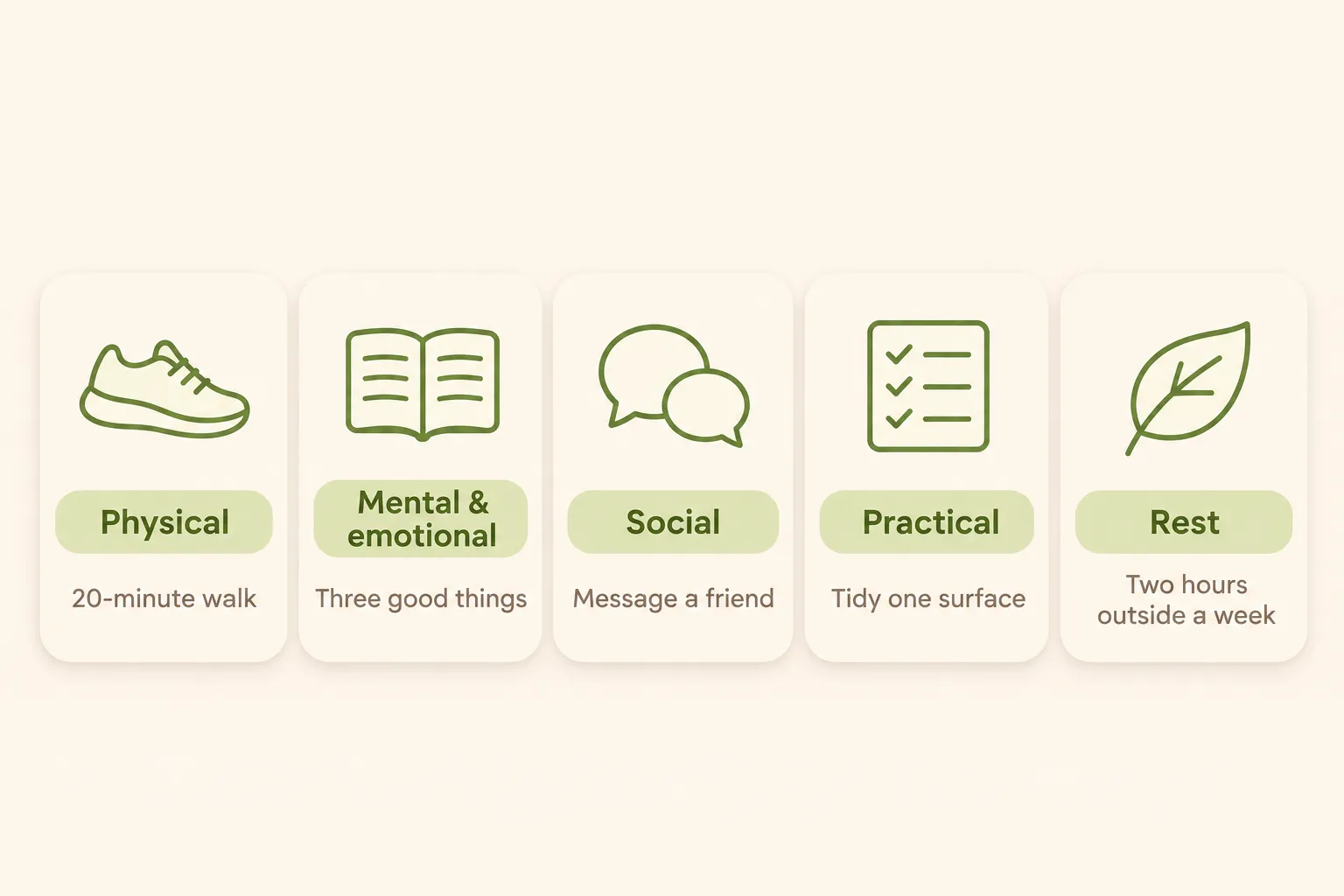
You’ll see self-care split into anywhere from five to eight areas. We’ve used five that cover most of what people mean: physical, mental and emotional, social, practical, and rest. The point isn’t the labels. It’s to notice if every habit you have sits in one area and another area is being ignored.
Physical self-care habits
- Go to bed within the same hour every night, weekends included.
- Get up at roughly the same time every day.
- Drink a glass of water when you get up.
- Walk for 20 minutes a day.
- Get outside in daylight before midday.
- Stretch for 5 minutes after sitting for a long time.
- Eat a proper lunch away from your desk.
- Add one portion of vegetables to dinner.
- Keep caffeine to the morning and early afternoon.
- Book the dentist, doctor or eye check-up you’ve been putting off.
- Take the stairs once a day.
- Leave your phone outside the bedroom.
Several of these are really sleep habits. If sleep is where you want to start, our guide to habits for better sleep covers them in more detail.
Why movement earns its place
Movement has unusually strong evidence behind it for how you feel, not just how you look. A 2023 overview of 97 systematic reviews, covering more than 1,000 trials and 128,000 adults, found that physical activity had medium-sized effects on symptoms of depression, anxiety and distress compared with usual care, and higher-intensity activity tended to help more. The authors note that many of the underlying reviews were of low quality, but the direction was consistent across very different groups of people.
You don’t need a gym for this. A brisk 20-minute walk, done most days, is a self-care habit and a movement habit at once.
Mental and emotional self-care habits
- Write three things that went well today, and why.
- Write three lines in a journal before bed.
- Breathe slowly for 2 minutes when you notice tension.
- Name the feeling when something upsets you, even just to yourself.
- Read for 15 minutes instead of scrolling.
- Spend 10 minutes on a hobby that has nothing to do with work.
- Turn off notifications for one app that stresses you.
- Have one screen-free hour before bed.
- Write down a worry and one small next step, then close the notebook.
- Listen to one album or podcast with nothing else going on.
The “three good things” exercise
Idea 13 comes from one of the best-known studies in positive psychology. In a randomised online study, Martin Seligman and colleagues gave 577 adults one of six week-long exercises. One of them was to write down, every night, three things that went well that day and why they happened. Of the 411 people who completed every follow-up, those who did this exercise were happier and less depressed six months later than at the start, while the placebo exercise had only short-lived effects. The researchers found that the lasting benefit went with how far people kept up the exercise on their own after the week ended.
It was one study with volunteers who chose to take part, so treat it as promising rather than proven. But it takes two minutes, costs nothing and fits neatly at the end of a day.
Social self-care habits
- Message one friend or family member a day.
- Call someone instead of texting, once a week.
- Eat one meal a week with other people.
- Say thank you to someone for something specific.
- Join one regular class, club or group.
- Plan one thing a month to look forward to with someone.
- Reply to the message you’ve been avoiding.
- Say no to one thing you don’t have room for.
Relationships are a health habit
It’s easy to treat seeing friends as a reward for when the real work is done. The evidence suggests it belongs on the main list. A meta-analysis of 148 studies following more than 300,000 people found that those with stronger social relationships had about a 50% greater likelihood of survival over the study periods. These were observational studies, so they show a link rather than proof that friendship causes longer life, but the size of the effect was comparable to well-known risks such as smoking.
A daily message takes less than a minute, and it’s one of the easiest self-care habits to track. If you’re looking after children too, our list of healthy habits for kids has ideas the whole family can share.
Practical self-care habits
- Spend 10 minutes tidying one surface each evening.
- Lay out tomorrow’s clothes before bed.
- Write tomorrow’s three most important tasks before you stop work.
- Check your bank balance once a week.
- Have one no-spend day a week.
- Prepare one lunch in advance.
- Empty your inbox to zero once a week, or at least clear the urgent part.
- Make your bed in the morning.
- Put things back where they live, straight away.
- Keep a short list of what’s due, and look at it every morning.
Practical self-care rarely feels like self-care in the moment. It shows up later, as the morning that isn’t a scramble.
Rest and nature habits
- Spend time outdoors in a park, garden, wood or by water.
- Take a proper lunch break, away from screens.
- Take one full evening a week off.
- Have a lie-in once a week without guilt.
- Sit outside with your morning drink.
- Take a 10-minute break after every 50 minutes of focused work.
- Do nothing for 5 minutes: no phone, no book.
- Have a bath or a long shower with no rush.
- Go somewhere new on foot once a month.
- Plan one whole day a month with nothing scheduled.
Two hours a week outside
In a study of nearly 20,000 people in England, Mathew White and colleagues found that people who had spent at least 120 minutes in nature in the past week were more likely to report good health and high wellbeing than those who had spent none. The benefits levelled off at around 200 to 300 minutes, and it didn’t matter whether the time came in one long visit or several short ones. It was a survey, so it shows a link and not a cause, but it gives you a useful target: two hours a week, in whatever pieces fit.
A self-care checklist for one day
If 50 ideas feels like too many, here’s one simple day that touches every area. Copy it, tick it, and change anything that doesn’t suit you.
That’s about 40 minutes in total, most of it built into things you already do.
How to choose your first three self-care habits
A list of 50 is a menu, not a plan. If you try to start ten habits on Monday, you’ll probably keep none of them by the end of the month. Start with three:
- One physical habit, ideally sleep or movement, because they support everything else.
- One habit from an area you’ve been neglecting. If you’re fine physically but haven’t spoken to a friend in weeks, choose a social one.
- One habit you genuinely want to do, so there’s something in the list you look forward to.
Then turn each one into an if-then plan: “After I make my morning coffee, I’ll drink a glass of water.” In a review of 94 studies, Peter Gollwitzer and Paschal Sheeran found that plans in this form had a medium-to-large effect on whether people followed through. Our guide on how to build a habit walks through the rest of the steps.
Give it time. A new daily habit can take anywhere from a few weeks to many months to feel automatic, so judge it after two months, not two weeks. We go into the numbers in how long it takes to form a habit.
When self-care isn’t enough
Self-care habits support your wellbeing; they don’t replace help when you need it. If you’ve felt low, anxious or not yourself for more than a couple of weeks, or if everyday things have become hard to manage, talk to your doctor or a mental health service. A walk and a journal are good companions to that help, not substitutes for it.
Track your self-care habits
Writing down what you did is a small self-care habit of its own. It shows you which habits are holding and which need a better cue. A sheet of paper on the fridge is enough: our free weekly habit tracker fits three habits and a week on one page.
If you’d rather use your phone, habitual is a habit tracker that keeps everything on the phone itself, with no account and no ads. Its free version covers up to 3 active habits, which is exactly where we’d suggest starting. A habit can be counted (“2 glasses of water before lunch”), timed with a built-in timer (“20 minutes outside”), or something you’re quitting (“no phone in bed”), and you can add a note to any day.
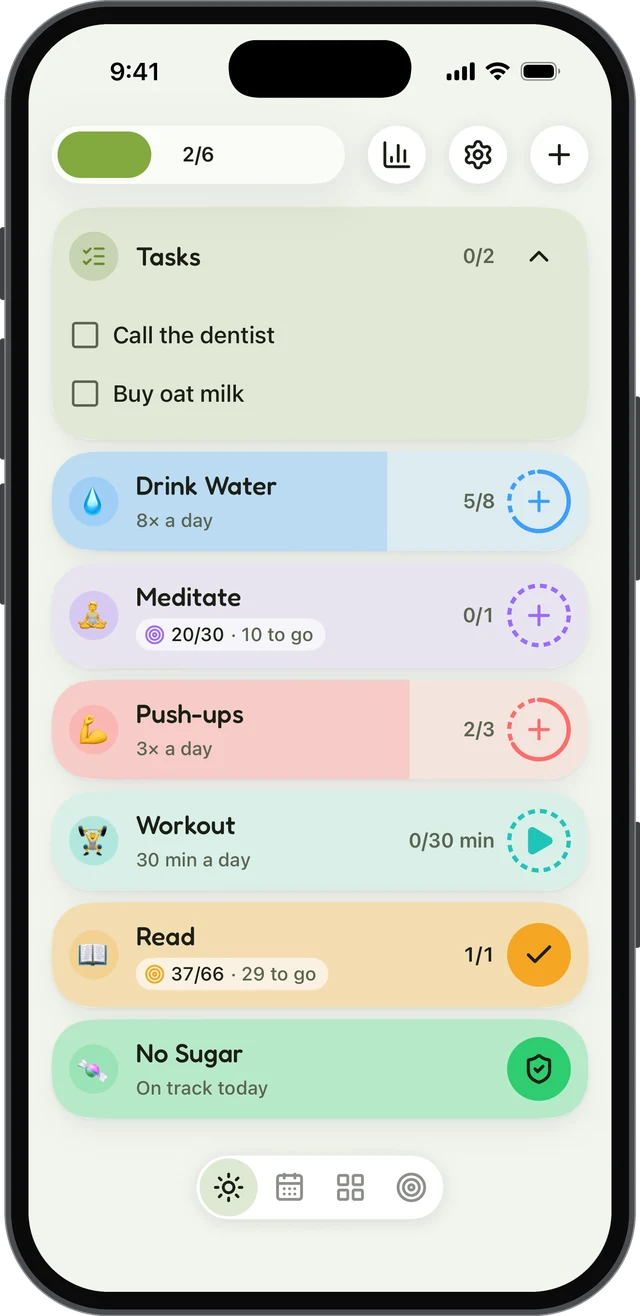
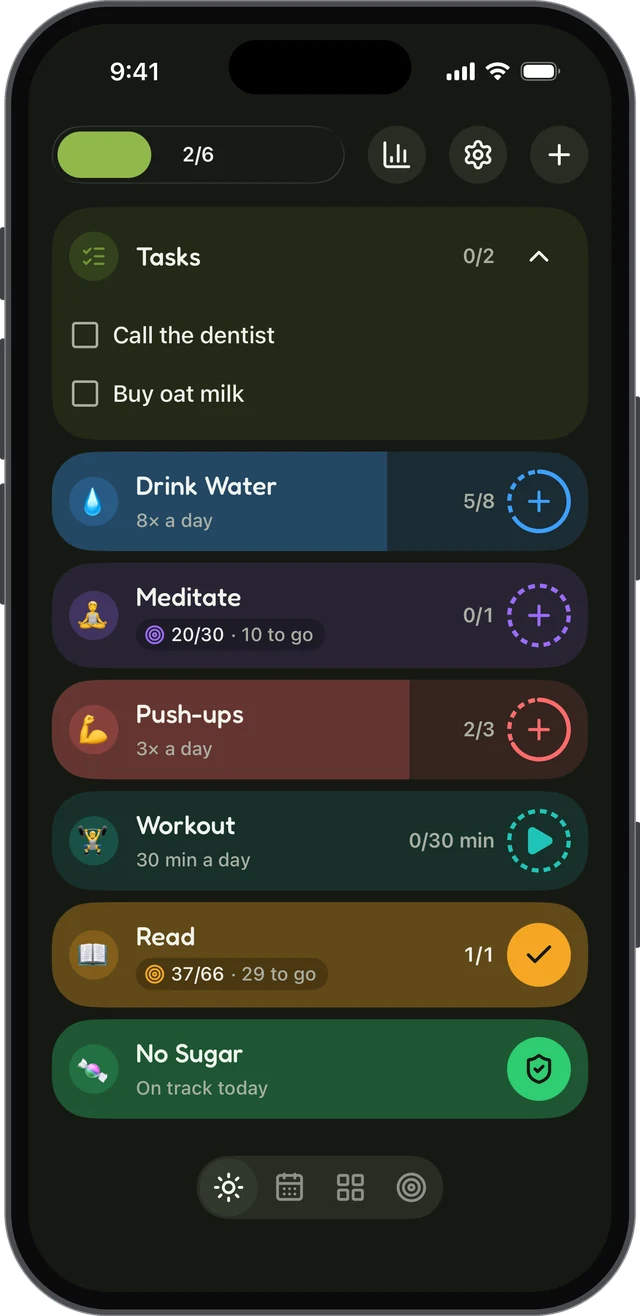
You can also set a goal for the habit that matters most, such as 30 days of walks. In habitual, goals only count up: a missed day never takes days away, it just moves the finish line out a little. That suits self-care better than a fragile streak, because the weeks when you most need it are often the ones when you miss a day. If that happens, read what to do after a missed day and carry on. And if you want more ideas beyond self-care, our list of 60 habits to track has them.
Sources
- Gollwitzer, P. M., & Sheeran, P. (2006). Implementation intentions and goal achievement: A meta-analysis of effects and processes. Advances in Experimental Social Psychology, 38, 69–119.
- Holt-Lunstad, J., Smith, T. B., & Layton, J. B. (2010). Social relationships and mortality risk: A meta-analytic review. PLoS Medicine, 7(7), e1000316.
- Seligman, M. E. P., Steen, T. A., Park, N., & Peterson, C. (2005). Positive psychology progress: Empirical validation of interventions. American Psychologist, 60(5), 410–421.
- Singh, B., Olds, T., Curtis, R., Dumuid, D., Virgara, R., Watson, A., Szeto, K., O’Connor, E., Ferguson, T., Eglitis, E., Miatke, A., Simpson, C. E., & Maher, C. (2023). Effectiveness of physical activity interventions for improving depression, anxiety and distress: An overview of systematic reviews. British Journal of Sports Medicine, 57(18), 1203–1209.
- White, M. P., Alcock, I., Grellier, J., Wheeler, B. W., Hartig, T., Warber, S. L., Bone, A., Depledge, M. H., & Fleming, L. E. (2019). Spending at least 120 minutes a week in nature is associated with good health and wellbeing. Scientific Reports, 9, 7730.
Questions
What are some good self-care habits?
Good self-care habits are small, regular things that look after your body, your mind and your relationships: a steady bedtime, a daily walk, a glass of water in the morning, a message to a friend, three lines in a journal. The best ones are specific enough that you can tell at the end of the day whether you did them.
What are the types of self-care?
Lists vary between five and eight areas, but most include physical, emotional, mental, social and practical self-care, and some add spiritual, environmental or financial. The labels matter less than balance: if all your self-care habits are in one area, add one from another.
How do I start a self-care routine?
Start with one to three small habits, not a full routine. Tie each one to something you already do, such as “after I make my morning coffee, I’ll drink a glass of water”, and keep it small enough to do on a bad day. Add more only once the first ones run on their own.
Is self-care selfish?
No. Sleeping enough, moving, eating regularly and staying in touch with people keep you well enough to show up for everything else, including the people who rely on you. Self-care becomes a problem only if it turns into avoiding things you need to deal with.
Keep reading
- Ideas
Morning Routine Ideas: 40 Small Habits and How to Keep Them
40 morning routine ideas, grouped by what they do, plus 5-, 15- and 30-minute routines and what research says about making morning habits stick. - Ideas
Healthy Habits for Kids: 45 Ideas and How to Make Them Stick
45 healthy habits for kids, grouped by sleep, food, play, teeth, screens and feelings, with the guidelines behind them and how to make them stick. - Ideas
Good Habits for Students: 40 Ideas Backed by Research
40 good habits for students, from study and sleep to phones and money, plus what research says works and how to start with just three.