

Habit science
Missed a Day? Why It Doesn’t Break Your Habit
Missing one day doesn’t undo a habit, and research backs that up. What actually matters is the next day. Here’s how to pick it back up without starting over.
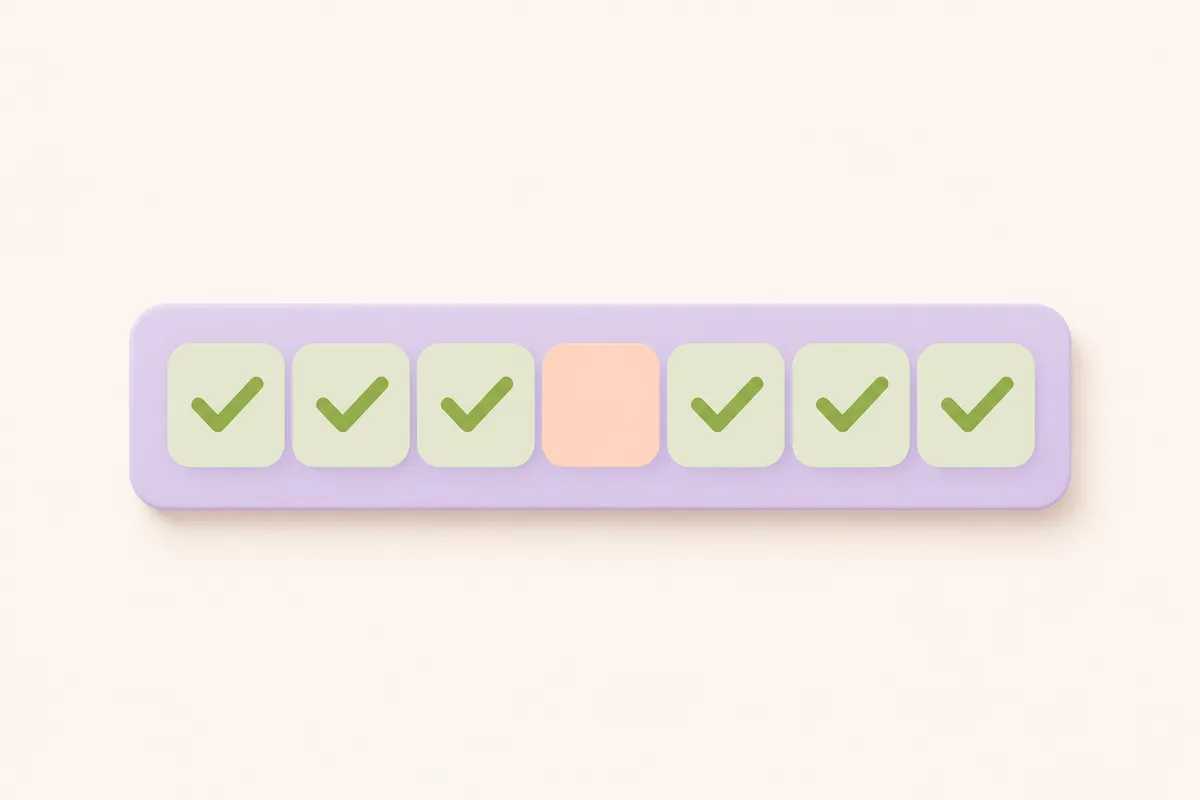
You were doing well. Nine days in a row, maybe thirty. Then a late night, a trip, a sick kid, and the day slipped past. The streak counter says zero, and somewhere in your head a voice says well, that’s that then.
It isn’t. One missed day doesn’t break a habit, and the research on how habits form says so plainly.
Does one missed day matter?
In the best-known study of how long habits take to form, researchers at University College London asked 96 people to do one new behaviour every day and to rate, each day, how automatic it felt. Some people missed days along the way.
The finding: missing a single opportunity did not noticeably affect how the habit formed. People who missed a day carried on climbing towards automaticity much as if they hadn’t. What did hold people back was being very inconsistent, missing often enough that the behaviour never settled into its cue.
In other words, the habit lives in the many repetitions, not in an unbroken chain.
Why a broken streak feels worse than it is
Streaks are motivating because they’re simple: one number that goes up. But that simplicity is also their problem. A streak treats day 31 after a miss as if days 1 to 30 never happened. It turns a small slip into a total loss, and that sense of loss is what makes people quit.
Psychologists call one version of this the “what-the-hell effect”: once a rule is broken, the rest of the day (or week) feels already ruined, so you stop trying. A streak counter going back to zero invites exactly that.
What to do the day after
- Do it today, even a tiny version. A 10-minute walk still counts on a day the 30-minute run won’t happen. The point is to keep the cue and the behaviour linked.
- Never miss twice. One miss is an accident. Two in a row is the start of a new habit, the one you didn’t want. Treat the day after a miss as the most important day of the week. Our guide on how to stay consistent puts this rule alongside seven other ways to keep a habit going.
- Look at the reason, not at yourself. Was it the time of day? A trip? A cue that wasn’t there? Change the plan: an earlier time, a backup cue, a smaller version for busy days.
- Count the total, not just the run. Thirty days out of thirty-one is a great month. Look at the days you’ve done, not at the gap.
- Plan for misses in advance. Decide now what the smallest acceptable form of it is. When a bad day comes, you won’t have to decide anything.
The same steps help when you’re breaking a habit rather than building one, where a slip is a day you did the thing you’re trying to stop. Our guide on how to break a bad habit covers how to plan for those slips.
Count days done, not just days in a row
This is why goals in habitual only count up. You set a number of days, like 30 or 66, and every day you do the habit counts towards it. A missed day never takes any away. It only moves the earliest finish date a little later.
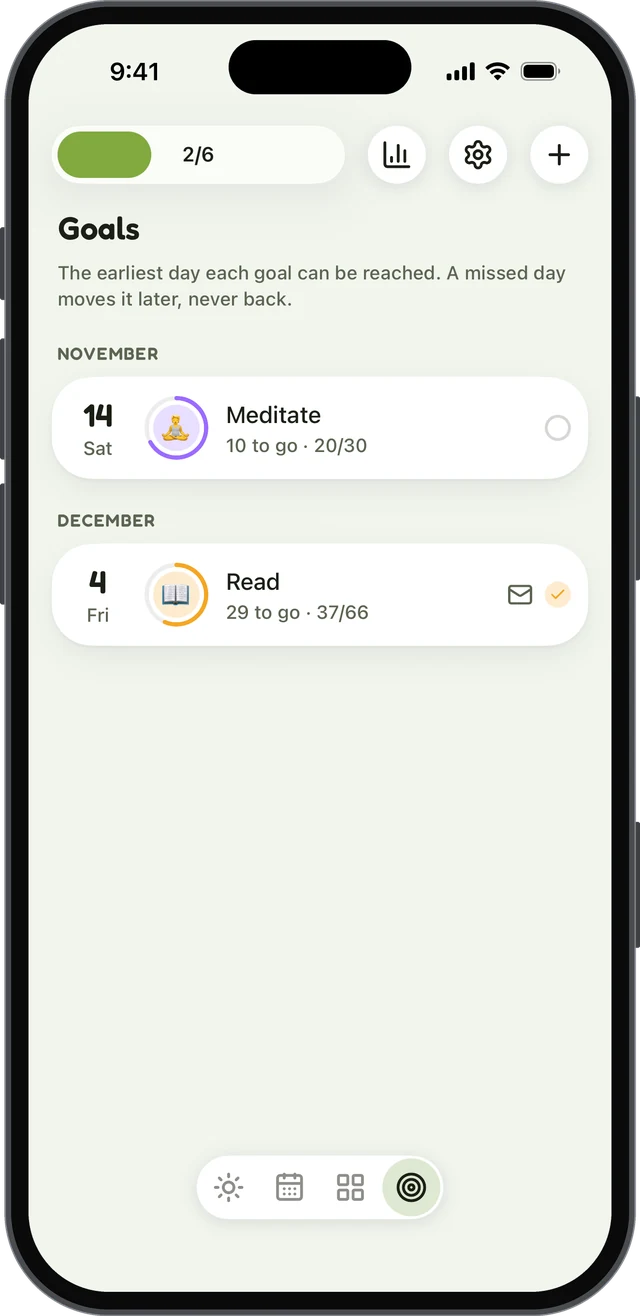
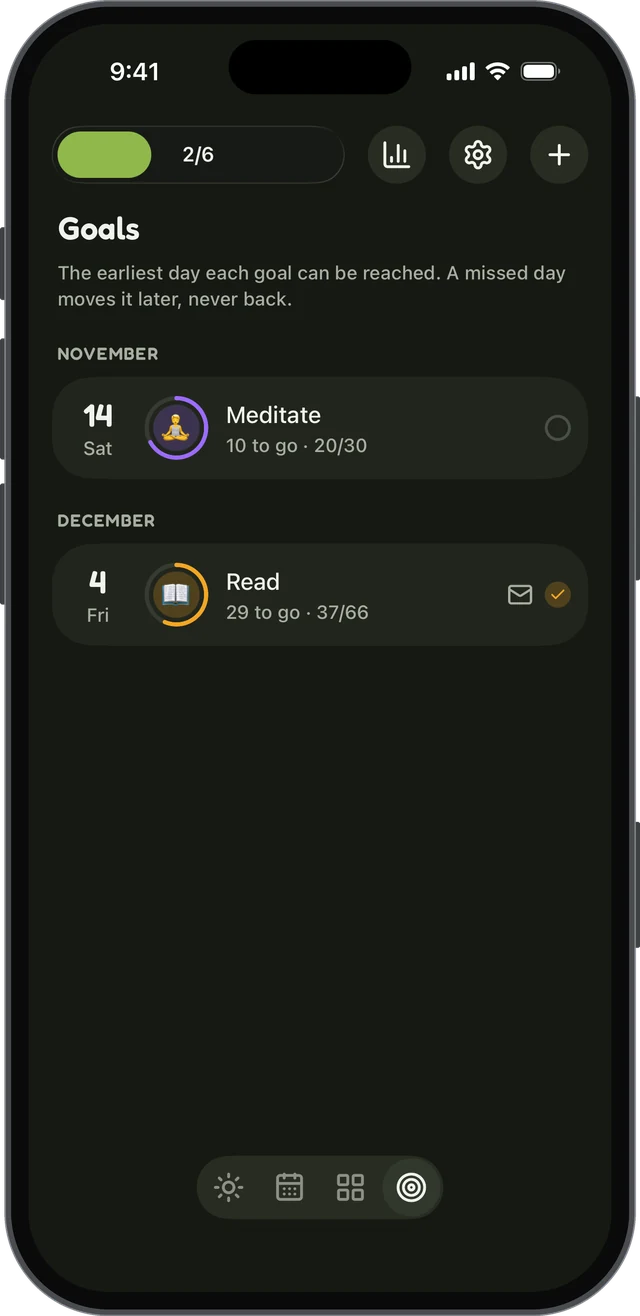
You still get a streak, because streaks are fun. But it sits next to your days done and your goal, so a missed day reads as what it is: a gap in a long run of days you showed up. Some apps are built around the streak instead: our comparison of Streaks and habitual shows how each one handles a missed day.
When a missed day becomes a missed week
Sometimes it’s not one day. Life happens: illness, a move, a new baby. If you’ve been away from a habit for a while:
- Restart smaller than before. Go back to the version that felt easy in the first week.
- Re-attach it to a cue. Your routine has probably changed, so the old cue may be gone. Pick a new one that happens every day now.
- Give yourself a head start. The days you did before still count. In habitual, you can set a new goal and give it the days you’d already done.
And if the habit doesn’t fit your life any more, it’s fine to archive it and pick something that does. Our list of habits to track has ideas.
The short version
- Missing one day doesn’t undo a habit. Research found it made no meaningful difference.
- The danger is the second miss. Never miss twice.
- Count days done, not only days in a row.
- Keep a tiny version of the habit ready for bad days.
If you want to know how long the whole process takes, read how long it takes to form a habit. (Spoiler: it’s not 21 days.)
Sources
- Lally, P., van Jaarsveld, C. H. M., Potts, H. W. W., & Wardle, J. (2010). How are habits formed: Modelling habit formation in the real world. European Journal of Social Psychology, 40(6), 998–1009.
- Polivy, J., & Herman, C. P. (1985). Dieting and bingeing: A causal analysis. American Psychologist, 40(2), 193–201.
Questions
Does missing one day ruin a habit?
No. In a study that followed people building a daily habit, missing a single day did not noticeably slow down how quickly it became automatic. Being very inconsistent did.
Should I start my streak over after a missed day?
Your streak counter resets, but your progress doesn’t. Count the days you’ve done in total rather than only the days in a row, and get back to it at the next chance.
What does 'never miss twice' mean?
It’s a rule of thumb: a single missed day is an accident, but two in a row starts a new pattern. If you’ve missed a day, make the next one count, even with a smaller version of the habit.
Keep reading
- Habit science
How Long Does It Take to Form a Habit? (Not 21 Days)
The 21-day rule is a myth. Research puts the median at 66 days, with a range from 18 to 254. Here’s what that means, and how to work with it. - Apps
Best Habit Tracker App for Android: 8 Options, Checked
The best habit tracker app for Android depends on what you need: free, no ads, no account, Wear OS or a game. Eight apps checked on their own pages. - Apps
Best Habitica Alternatives: 7 Habit Trackers, Checked
The best Habitica alternatives, whether you want to keep the game or drop it: seven habit trackers checked for platforms, pricing and accounts.