
Guide
How to Break a Bad Habit: 7 Steps That Work (With Research)
How to break a bad habit for good: find the cue, change your surroundings, plan a replacement and watch for slips. Seven steps, each backed by research.
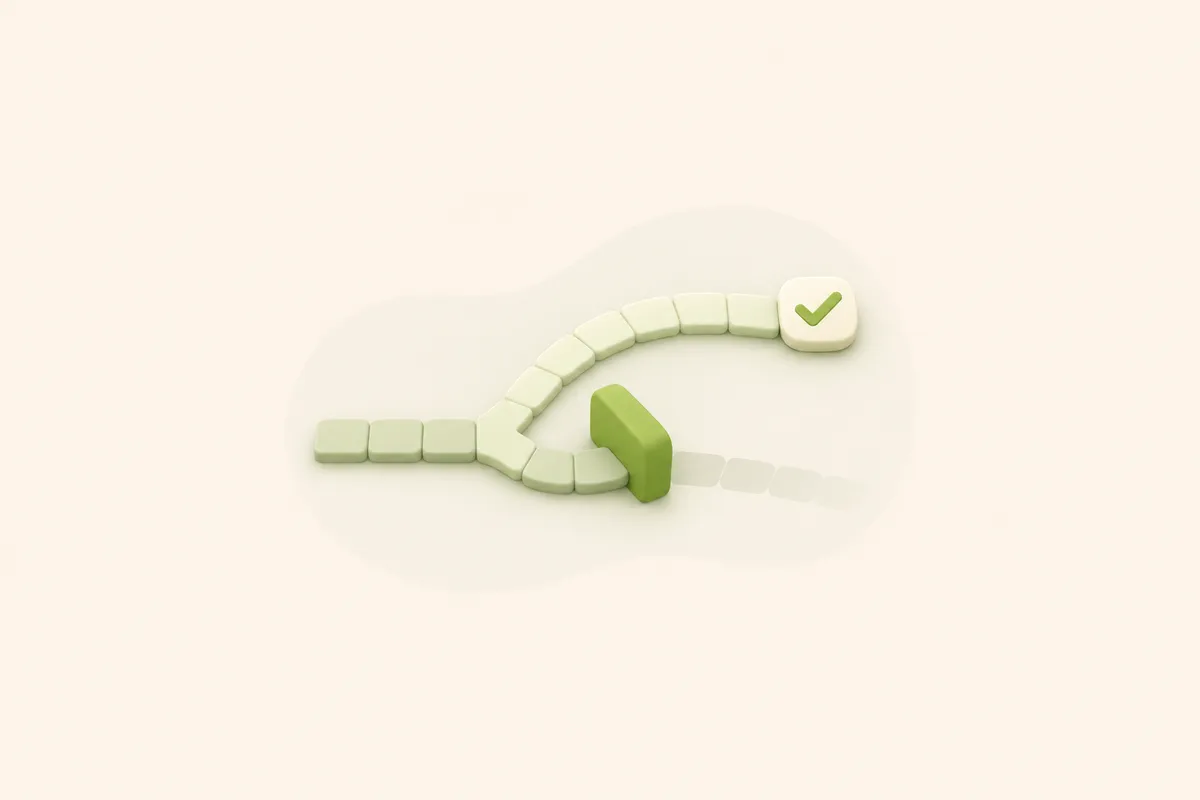
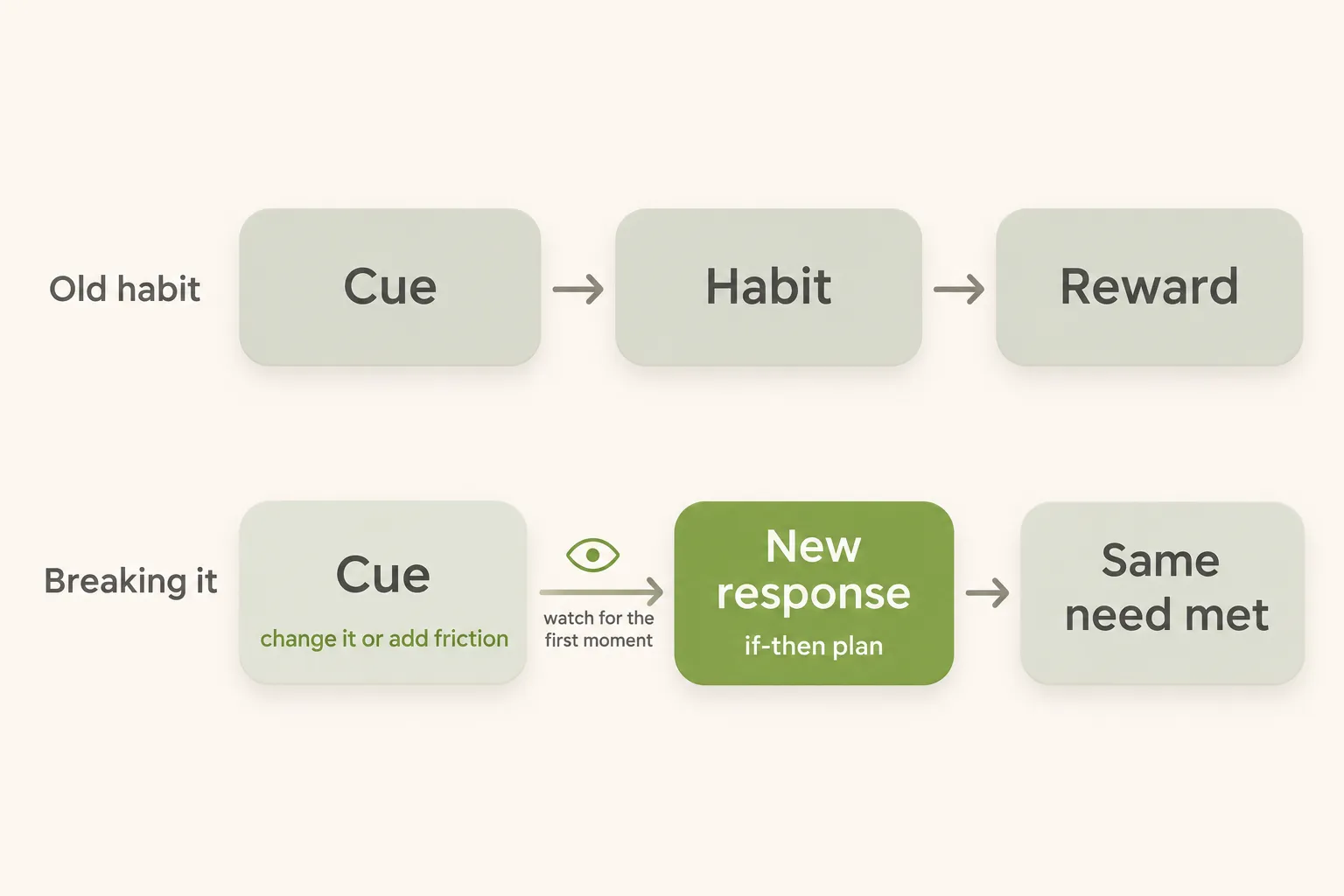
If you want to know how to break a bad habit, start with the moment it begins, not with willpower. Find the cue that sets it off, change or avoid that cue where you can, decide in advance what you’ll do instead, and watch closely for slips until the new response takes over.
This guide explains why bad habits are so hard to break, then gives seven steps to break a bad habit, each one tied to what research has actually found. It works for everyday habits like scrolling in bed, snacking in the evening or biting your nails.
Why bad habits are so hard to break
A habit is a behaviour your brain has linked to a situation. Do something often enough in the same place, at the same time or after the same feeling, and the situation itself starts the behaviour. You pick up your phone in bed because you’re in bed, not because you decided to.
In their review of habit research, Wendy Wood and Dennis Rünger describe habits as the brain’s efficient, default way of responding: people tend to repeat the same behaviours in recurring contexts, and those responses run with little thought. That’s useful for tying your shoes. It’s a nuisance when the default is a second glass of wine.
It also explains the most frustrating part. You can sincerely want to stop and still do it, because wanting to stop changes your goal, not the cue. That’s why the steps below aim at the situation, not at trying harder.
How to break a bad habit in 7 steps
1. Write down when it happens
Before you change anything, spend three or four days noticing. Each time you catch yourself doing the habit, write down:
Most people find the same two or three cues come up again and again: lying in bed, the first quiet moment after work, a particular feeling like boredom or worry. Those cues are what you’ll work on. You’ll also learn what the habit gives you (a break, comfort, something to do with your hands), which you’ll need for step 4.
2. Change the situation that cues it
Because the cue drives the habit, changing the situation is one of the most reliable ways to weaken it.
A study by Wood, Tam and Witt followed students as they transferred to a new university. Their exercise, newspaper and TV-watching habits only survived the move when parts of the old setting carried over, such as reading the paper with other people. When the setting changed, the habit was disrupted, and in some cases behaviour came under the students’ conscious intentions again.
You don’t need to move house to use this. Small changes to the setting do the same work on a smaller scale:
- Charge your phone outside the bedroom if scrolling in bed is the habit.
- Sit in a different chair, or a different room, in the evening.
- Take a different route home if it passes the shop where you buy snacks.
Life changes, like a new job, a move or a holiday, are also a good time to drop a habit, because so many of its cues disappear at once.
3. Add friction
If you can’t remove the cue, make the habit a little harder to do. Log out of the app after every use. Keep the biscuits on a high shelf in an opaque tin. Put the game controller in a drawer in another room.
Friction won’t stop a strong habit on its own, but it creates a pause, and a pause is where you get to choose. The few seconds it takes to log back in are a few seconds for step 4 to kick in.
4. Plan a replacement with an if-then rule
An unwanted habit usually does something for you. If you take it away and leave a gap, the old behaviour tends to slip back into it. So decide in advance what you’ll do instead, and write it as an if-then plan:
If I [cue], then I will [new response].
Some examples:
- If I get into bed, then I’ll read a page of my book instead of picking up my phone.
- If I feel the urge to bite my nails, then I’ll press my fingertips together for a minute.
- If I get home and want a snack, then I’ll make a cup of tea first.
In three experiments, Marieke Adriaanse and colleagues found that plans like these took away the old habit’s head start: normally the habitual response came to mind first in the critical situation, but after people made an if-then plan, it no longer did. The catch is useful to know. The plan gave people the freedom to choose, but they only acted differently when they really wanted the alternative. Pick a replacement you’d actually like to do.
The replacement works best when it meets the same need. If scrolling is how you unwind, a page of a novel unwinds you too. If a cigarette is your excuse for a break outside, take the break and leave the cigarette.
5. Watch for it, especially when it’s strong
Here’s a finding that sounds too simple to be true. In two diary studies, Jeffrey Quinn and colleagues asked people how they tried to control their bad habits. For strong habits, the strategy that worked best was vigilant monitoring: watching carefully for slip-ups and telling yourself “don’t do it” when the urge comes. No other strategy they looked at helped with strong habits. A follow-up experiment suggested monitoring doesn’t weaken the habit itself; it boosts your ability to stop it in the moment.
This is the same idea at the heart of habit reversal, a structured therapy built on becoming aware of a habit as it starts and then doing a competing response that’s physically incompatible with it, like clenching your fists instead of pulling your hair. In a meta-analysis of 18 studies with 575 participants, Bate and colleagues found habit reversal had a large effect on repetitive behaviours such as nail biting, thumb sucking, tics and stuttering.
You can borrow the principle on your own: learn the first moment of the habit (the hand moving to your mouth, the thumb hovering over the app) and make that moment your signal to switch.
6. Track the days you didn’t do it
Keeping a record turns vigilance into something you can see. A meta-analysis of 138 studies with nearly 20,000 people by Benjamin Harkin and colleagues found that monitoring your progress helps you reach a goal, and the effect was larger when people physically recorded their progress or made it public.
For a habit you’re breaking, track the days you didn’t do it, not the days you did. Each one is a small win you can count. If you’re choosing an app for this, our comparison of the best apps to break bad habits looks at eight of them.
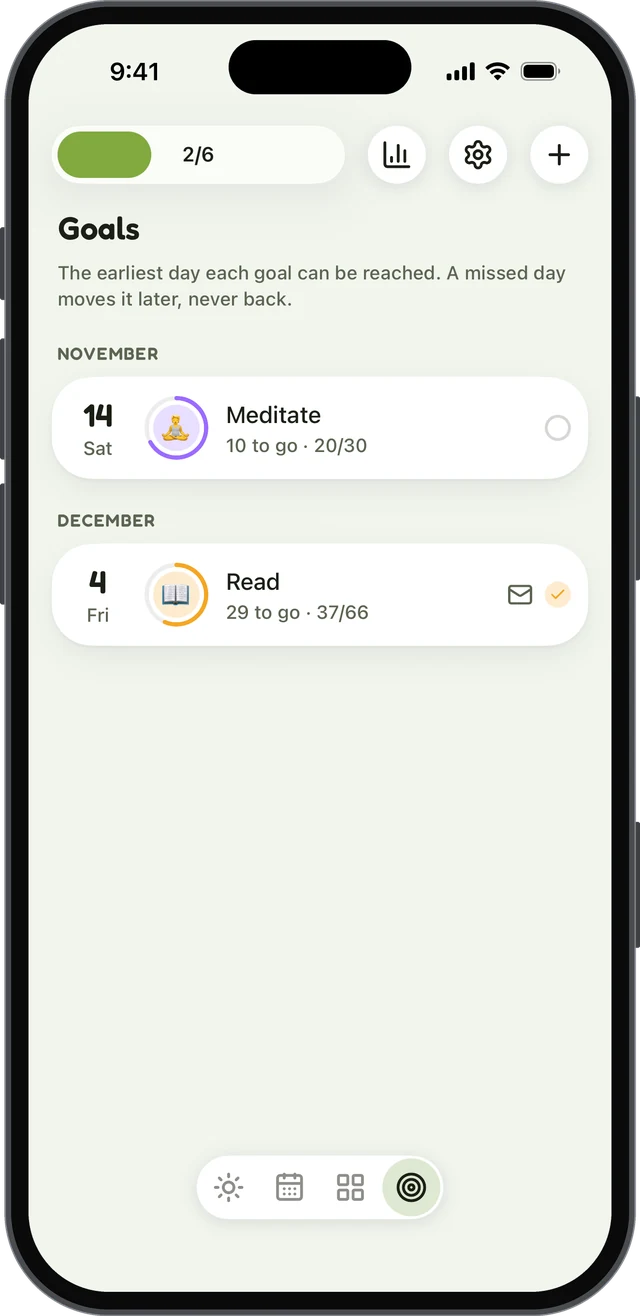
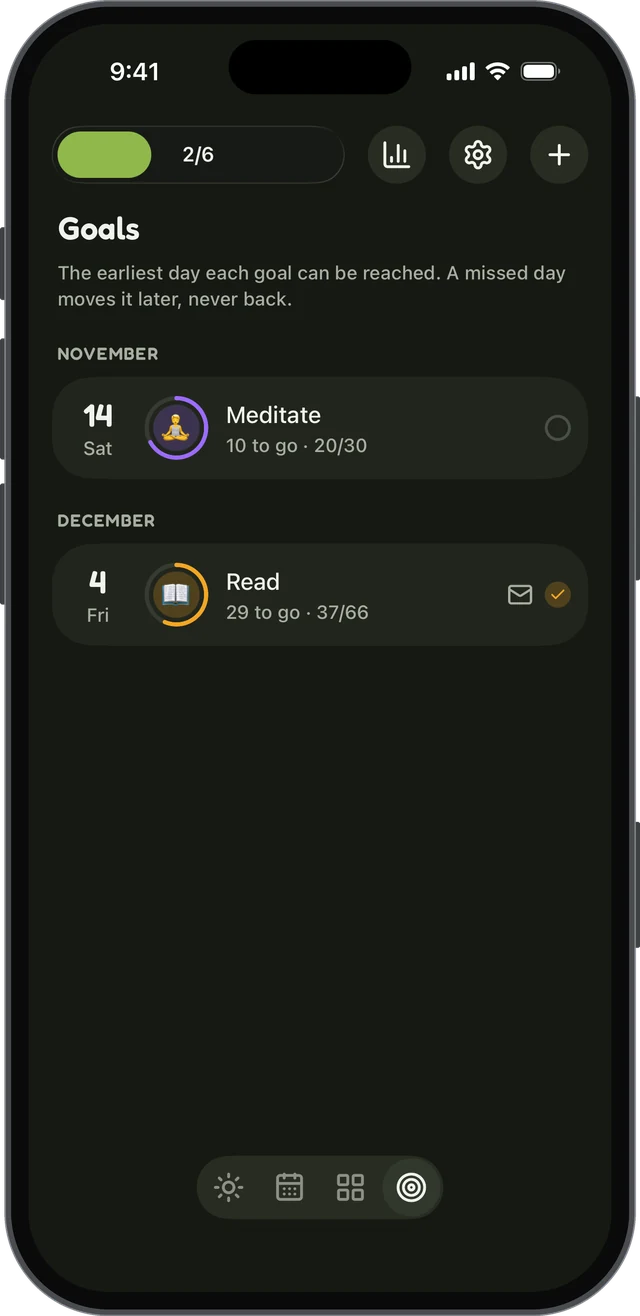
habitual, a habit tracker that keeps everything on your phone, has a habit type for exactly this: something you’re quitting. You can set reminders and check-ins for it, and give it a goal of days. Goals in habitual only count up, so a slip never wipes out the days you’ve already managed; it just moves the finish line a little later.
If you prefer paper, a printable habit tracker works just as well. Cross off each day you didn’t do it.
7. Plan for slips before they happen
You will slip. Almost everyone does, and it says nothing about whether you can break the habit. What matters is what you do the day after.
Decide now how you’ll handle it:
If you find a single slip hard to shake off, our guide on what to do after a missed day covers why one lapse matters far less than it feels.
How long does it take to break a bad habit?
There’s no reliable number. Popular figures like 21 days don’t come from research on breaking habits, and the old cue can stay linked to the behaviour in your memory for a long time. That’s why Quinn’s study found vigilance mattered: the habit trace is slow to change, so you keep stopping it in the moment until the new response takes over.
What we do know is that building the replacement habit takes time. In a study of 96 people who each repeated one new daily behaviour, Phillippa Lally and colleagues found it took between 18 and 254 days for it to become as automatic as it was going to get. It was a small study of simple habits, but the range alone shows there’s no single answer. Our article on how long it takes to form a habit goes through the evidence. Plan for a few months of attention, not a few weeks, and expect the urges to get weaker and rarer rather than vanish on a set date.
Examples: breaking common bad habits
Here’s how the steps fit together for five common habits.
Scrolling in bed. Cue: getting into bed. Change the situation: charge your phone in another room and use a cheap alarm clock. Replacement: a book on the pillow. Track: nights without the phone.
Snacking in the evening. Cue: sitting down after dinner, or boredom. Friction: no snacks in the living room, a high shelf for the rest. Replacement: a cup of tea, or brushing your teeth early. Track: evenings without a snack.
Biting your nails. Cue: stress, reading, screens. Watch for the first moment your hand moves to your mouth. Competing response: press your fingertips together or hold something for a minute. Track: days without biting.
Checking email first thing. Cue: picking up the phone when you wake. Change the situation: move email off the home screen. Replacement: if I wake up, then I’ll open the curtains and drink a glass of water first. Track: mornings without email before breakfast.
Hitting snooze. Cue: the alarm. Change the situation: put the alarm across the room, so you have to get up to turn it off. Track: mornings you got up at the first alarm.
Once the bad habit is under control, the replacement is a new habit to build. Habit stacking is a good way to anchor it to something you already do.
When to get help
These steps are for everyday habits. If the habit is an addiction (smoking, alcohol, drugs, gambling), causes you harm, or you’ve tried many times and can’t stop, talk to a doctor or a trained professional. For repetitive behaviours like hair pulling, skin picking or tics, ask about habit reversal therapy, which is delivered by trained clinicians. In the UK, the NHS lists where to get support for addiction.
The short version
- Find the cue: where, when, who with and what you were feeling.
- Change the situation where you can, and add friction where you can’t.
- Decide in advance what you’ll do instead, with an if-then plan, and pick something that meets the same need.
- Watch for the first moment of the habit and switch there.
- Track the days you didn’t do it, and expect slips.
If you’re replacing the habit with a better one, our guide on how to build a habit that sticks takes it from there.
Sources
- Adriaanse, M. A., Gollwitzer, P. M., De Ridder, D. T. D., de Wit, J. B. F., & Kroese, F. M. (2011). Breaking habits with implementation intentions: A test of underlying processes. Personality and Social Psychology Bulletin, 37(4), 502–513.
- Bate, K. S., Malouff, J. M., Thorsteinsson, E. T., & Bhullar, N. (2011). The efficacy of habit reversal therapy for tics, habit disorders, and stuttering: A meta-analytic review. Clinical Psychology Review, 31(5), 865–871.
- Harkin, B., Webb, T. L., Chang, B. P. I., Prestwich, A., Conner, M., Kellar, I., Benn, Y., & Sheeran, P. (2016). Does monitoring goal progress promote goal attainment? A meta-analysis of the experimental evidence. Psychological Bulletin, 142(2), 198–229.
- Lally, P., van Jaarsveld, C. H. M., Potts, H. W. W., & Wardle, J. (2010). How are habits formed: Modelling habit formation in the real world. European Journal of Social Psychology, 40(6), 998–1009.
- Quinn, J. M., Pascoe, A., Wood, W., & Neal, D. T. (2010). Can’t control yourself? Monitor those bad habits. Personality and Social Psychology Bulletin, 36(4), 499–511.
- Wood, W., & Rünger, D. (2016). Psychology of habit. Annual Review of Psychology, 67, 289–314.
- Wood, W., Tam, L., & Witt, M. G. (2005). Changing circumstances, disrupting habits. Journal of Personality and Social Psychology, 88(6), 918–933.
Questions
How long does it take to break a bad habit?
There’s no reliable number, and anyone who gives you one (21 days, 30 days) is guessing. In one study of new habits, it took people anywhere from 18 to 254 days for a behaviour to become automatic, and an old habit’s cue can stay linked to it for longer than that. Expect a few months of watching for the cue, with slips getting rarer over time.
Why are bad habits so hard to break?
Because a habit is triggered by its cue, not by a decision. Once a behaviour has been repeated often enough in the same situation, the situation starts it before you’ve had a chance to think. Good intentions change what you want, but they don’t change the cue, which is why changing the situation works better than willpower alone.
Is it better to replace a bad habit or just stop?
Replacing it usually works better. A bad habit often does something for you, such as easing stress or filling a quiet moment, and an empty gap tends to get filled by the old behaviour again. Decide in advance what you’ll do instead when the cue appears, and pick something that meets the same need.
What should I do if I slip up?
Treat it as information, not failure. Note what cued it, adjust your plan for that situation, and carry on the next day. One slip doesn’t undo the days you managed, and counting those days rather than an unbroken streak makes it easier to keep going.
Keep reading
- Guide
How to Stay Consistent: 8 Ways That Don’t Need Motivation
How to stay consistent when motivation fades: eight research-backed ways to keep a habit going, plan for missed days and count your progress. - Guide
Habits for Better Sleep: 9 That Work and How to Keep Them
Nine habits for better sleep, from a fixed wake time to a caffeine cut-off, what the research says about each, and how to make them stick. - Guide
Habit Stacking: How to Use It (With 30 Examples)
Habit stacking ties a new habit to one you already do. Here’s the formula, what research says about it, how to pick an anchor, and 30 examples.