
Guide
Habits for Better Sleep: 9 That Work and How to Keep Them
Nine habits for better sleep, from a fixed wake time to a caffeine cut-off, what the research says about each, and how to make them stick.
The habits for better sleep that make the most difference are mostly boring ones: get up at the same time every day, stop caffeine by mid-afternoon, keep alcohol and bright screens out of the last hours before bed, and give yourself a short wind-down. None of them is hard on its own. The hard part is doing them every night.
This guide covers nine healthy sleep habits, what the research actually says about each one (including where it’s thinner than the advice suggests), and how to turn them into habits that stick rather than a list you try for a week.
What sleep hygiene can and can’t do
“Sleep hygiene” is the name for everyday habits that support sleep: timing, caffeine, alcohol, exercise, the bedroom and so on. It’s worth knowing its limits before you start.
In a review of the evidence for sleep hygiene, Leah Irish and colleagues found that research generally supports a link between each recommendation and night-time sleep. But they also noted that the direct effect of changing these habits had been tested surprisingly little in the general population, and that sleep hygiene education on its own isn’t an effective treatment for clinical insomnia.
So treat these habits as the foundation, not a cure. They help most people sleep a bit better. If you have long-standing insomnia, they’re a starting point, and there’s more on getting proper help at the end.
9 habits for better sleep
1. Get up at the same time every day
If you change only one thing, make it your wake time. Pick a time you can keep on weekdays and weekends, and get out of bed then, even after a bad night.
Regularity matters more than it sounds. In a study of 60,977 UK Biobank participants who wore activity trackers, Daniel Windred and colleagues found that people with more regular sleep–wake timing had a lower risk of dying over the following years, and that regularity predicted this better than sleep duration did. It’s an observational study, so it shows a link rather than proof that regular sleep causes better health, but it fits with what sleep clinics advise.
2. Go to bed when you’re sleepy, and get up if you can’t sleep
A fixed wake time works best with a flexible bedtime. The NHS advice for insomnia is to go to bed only when you feel sleepy, and not to sleep in after a bad night. Lying in bed wide awake teaches your brain that bed is a place for lying awake.
If you’re still awake after what feels like a while, get up, do something quiet in dim light, and go back when you feel sleepy. Don’t watch the clock while you do it.
3. Set a caffeine cut-off
Caffeine lasts longer than most people think. In a controlled study by Christopher Drake and colleagues, people took a large dose of caffeine (400 mg) at bedtime, three hours before or six hours before, or a placebo. All three caffeine times disturbed sleep compared with the placebo, including the dose six hours before bed. The authors concluded that people should avoid substantial caffeine for at least six hours before bed. The study was small and used a high dose, so a single morning coffee isn’t the problem; the afternoon ones might be.
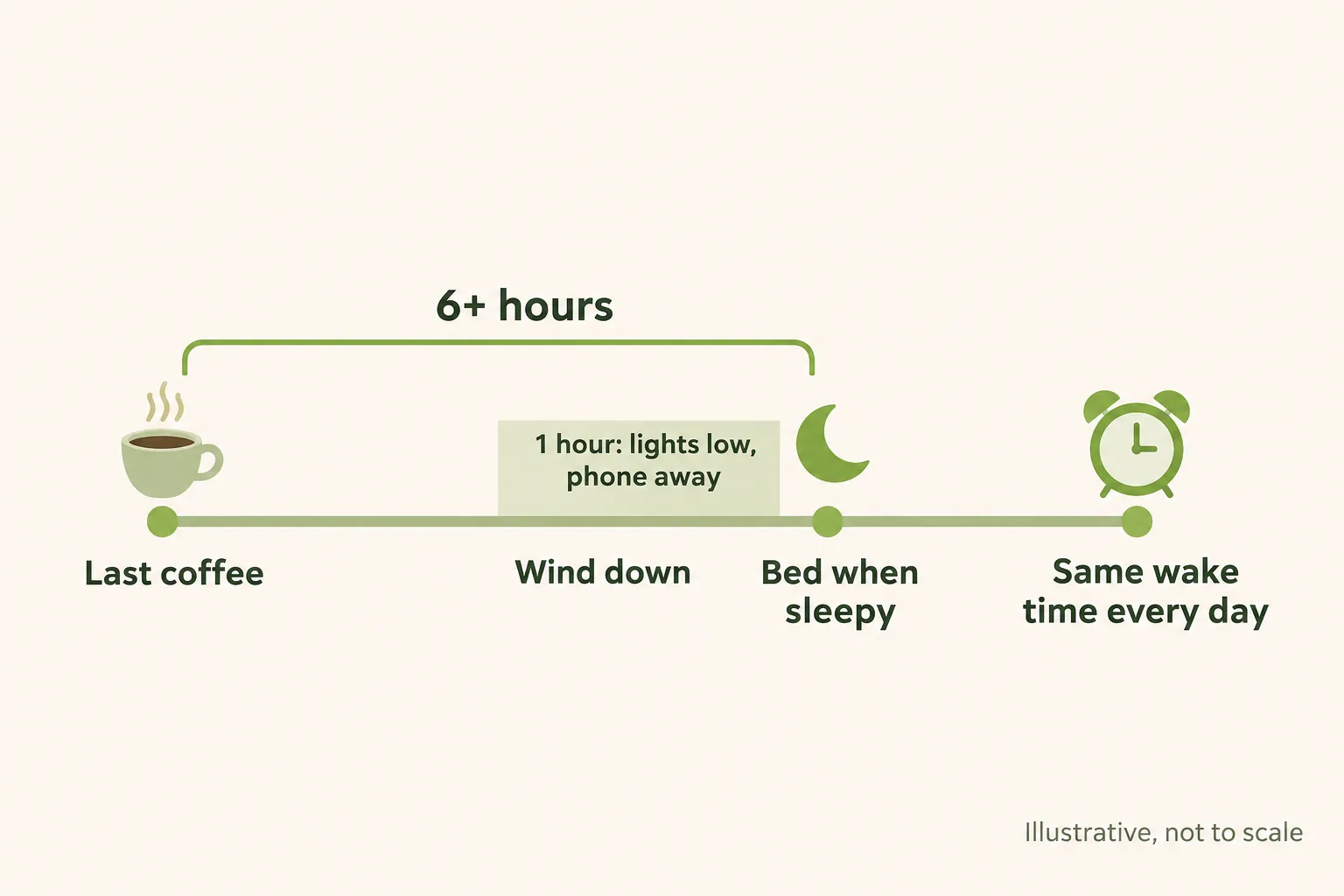
A simple rule: if you go to bed at 11, your last coffee or strong tea is before 5. If you’re sensitive, make it lunchtime. Remember that cola, energy drinks and some pre-workout powders contain caffeine too.
4. Don’t use alcohol as a sleep aid
A drink can make you fall asleep faster, which is why so many people use one to wind down. The trouble comes later. In a review of studies on alcohol and sleep, Irshaad Ebrahim and colleagues found that, at all doses, alcohol shortened the time to fall asleep but increased sleep disruption in the second half of the night. It also delayed the first period of REM sleep.
If you drink in the evening, have it earlier, have less, and swap the nightcap for something else you enjoy, like a herbal tea or a warm bath.
5. Dim screens and lights in the last hour
Light in the evening tells your body clock it’s still daytime. In a lab study by Anne-Marie Chang and colleagues, 12 young adults read either on a light-emitting tablet or from a printed book for about four hours before bed, on five evenings in a row. After the tablet, they took nearly 10 minutes longer to fall asleep, their evening melatonin was suppressed by about half, and their body clock shifted more than an hour and a half later. It’s a small study with an unusually long reading session, so don’t expect a few minutes on your phone to have the same effect.
The bigger problem with phones in bed is often what’s on them, not the light: one more video, one more message. The easiest fix is distance.
6. Give yourself a wind-down routine
The NHS suggests relaxing for at least an hour before bed, for example with a bath or a book. A routine helps because the same steps in the same order become a cue for sleep, just as a morning routine becomes a cue to get going.
Keep it short and pleasant, so you’ll actually do it. For example: dishes done, lights down, wash, ten pages of a book, lights out. If worries keep you awake, add two minutes with a notebook to write tomorrow’s to-do list, so it’s out of your head and on paper.
7. Move during the day, and go easy late at night
Regular exercise is part of almost every list of sleep tips, and the worry has long been that exercising in the evening keeps you awake. The evidence is more reassuring than that. In a systematic review and meta-analysis of 23 studies, Jan Stutz and colleagues found that a single session of evening exercise didn’t harm sleep in healthy adults, and if anything slightly increased deep sleep. The exception was vigorous exercise ending within about an hour of bedtime, which might make it harder to fall asleep.
So a walk after dinner or an evening class is fine. Save the hardest sessions for earlier, or leave at least an hour between finishing and going to bed. (The NHS advice for people with insomnia is more cautious, at four hours, so if you already sleep badly, start there.)
8. Make the bedroom dark, quiet and comfortable
A room that’s dark, quiet and comfortable makes everything else easier. The NHS suggests curtains or blinds, an eye mask or ear plugs if you need them, and a comfortable mattress, pillows and covers.
Look at your room at night with the lights off. Standby lights, a street lamp through a gap in the curtains or a phone screen lighting up with notifications are all easy to fix.
9. Be careful with naps and late meals
If you sleep well at night, a short nap can be fine. If you struggle to sleep at night, the NHS advises against daytime naps, because they use up the sleep pressure you need at bedtime. It also advises against a big meal late at night. If you’re hungry before bed, a small snack is better than going to bed hungry or overfull.
How to make healthy sleep habits stick
Most people already know some of the advice above. Knowing it isn’t the problem. Doing it at 11 at night, tired, with a phone in your hand, is. These steps help turn sleep tips into habits.
Start with one or two
Nine new habits at once is a recipe for doing none of them. Pick the one or two that would make the biggest difference for you. For most people that’s the fixed wake time plus one evening habit, such as the caffeine cut-off or the phone outside the bedroom. Add another only when those feel automatic.
Write an if-then plan
Decide in advance exactly when and where you’ll do the new habit: “If I finish dinner, then I’ll put my phone on the charger in the hall.” Plans like this are called implementation intentions. In a meta-analysis of 94 independent tests, Peter Gollwitzer and Paschal Sheeran found they had a medium-to-large effect on reaching goals. Linking the new habit to something you already do every evening is the same idea as habit stacking.
Track it for a few weeks
Ticking off each night you kept the habit makes it visible, and shows you which ones you actually keep. habitual, a habit tracker that keeps everything on your phone, lets you log a sleep habit with one tap and set a reminder for the evening. You can also make it something you’re quitting, like coffee after 3 pm, and add a note on any day (“slept badly after a late coffee”) to spot patterns.
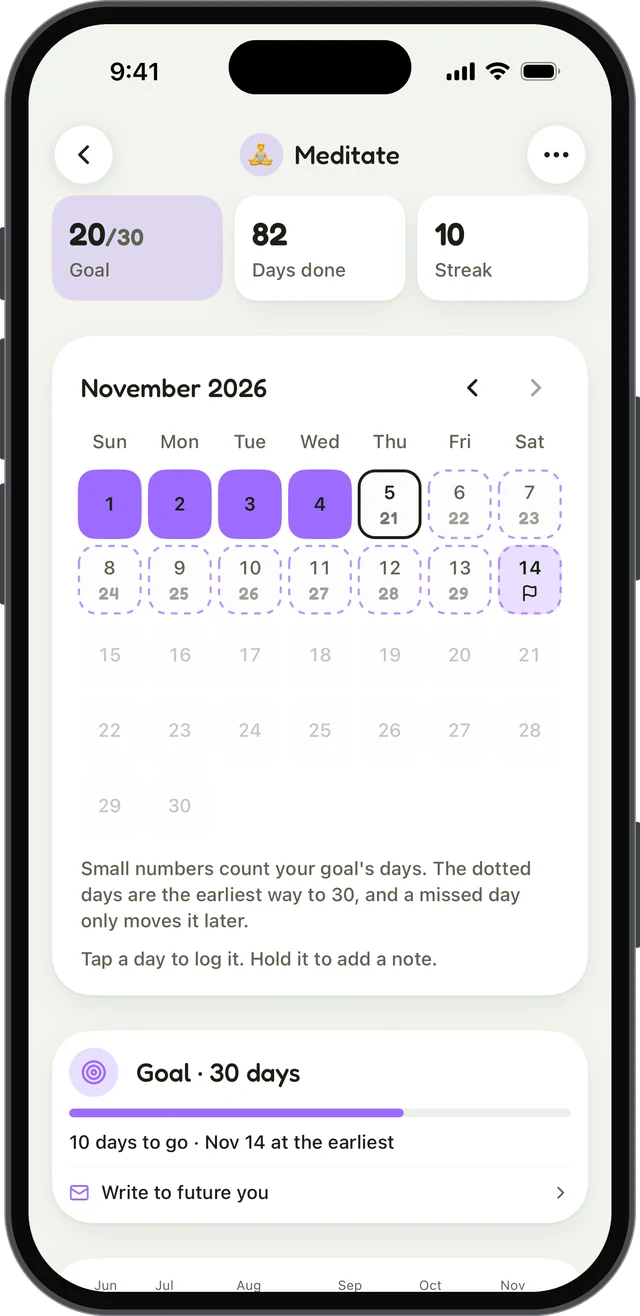
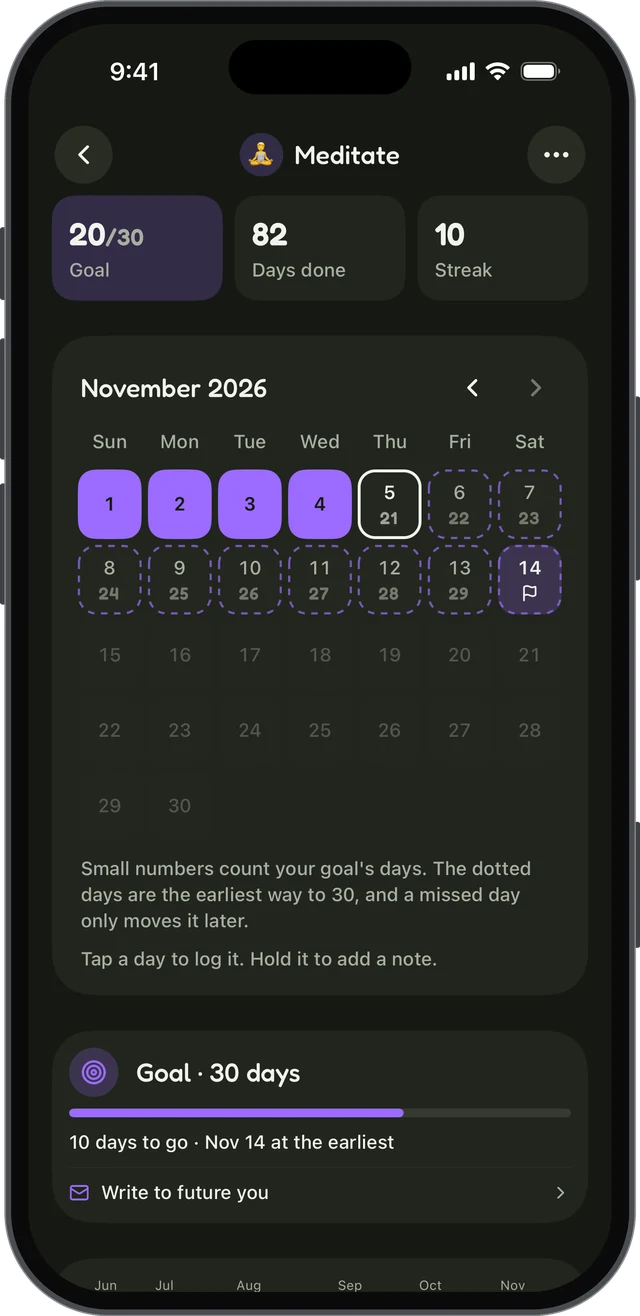
If you prefer paper, our free printable habit tracker has room for a month of sleep habits.
Expect it to take a while, and don’t panic about a bad night
Sleep habits take longer to become automatic than the popular “21 days” suggests, and the time varies a lot from person to person. We explain the research in how long it takes to form a habit, and why one missed day doesn’t break a habit.
A late night out or a night of broken sleep isn’t a failure. Get up at your usual time the next morning and carry on.
When better habits aren’t enough
Good sleep habits help most people, but they’re not a treatment for every sleep problem. The NHS suggests seeing a GP if changing your sleeping habits hasn’t helped, if you’ve had trouble sleeping for months, or if it’s affecting your daily life in a way that makes it hard to cope. Insomnia that lasts three months or more is called long-term insomnia, and you may be offered cognitive behavioural therapy for insomnia, which works on the thoughts and behaviours that keep you awake.
Loud snoring, gasping in your sleep or feeling very sleepy during the day despite enough time in bed are also worth mentioning to a doctor.
Sources
- Chang, A.-M., Aeschbach, D., Duffy, J. F., & Czeisler, C. A. (2015). Evening use of light-emitting eReaders negatively affects sleep, circadian timing, and next-morning alertness. Proceedings of the National Academy of Sciences, 112(4), 1232–1237.
- Drake, C., Roehrs, T., Shambroom, J., & Roth, T. (2013). Caffeine effects on sleep taken 0, 3, or 6 hours before going to bed. Journal of Clinical Sleep Medicine, 9(11), 1195–1200.
- Ebrahim, I. O., Shapiro, C. M., Williams, A. J., & Fenwick, P. B. (2013). Alcohol and sleep I: Effects on normal sleep. Alcoholism: Clinical and Experimental Research, 37(4), 539–549.
- Gollwitzer, P. M., & Sheeran, P. (2006). Implementation intentions and goal achievement: A meta-analysis of effects and processes. Advances in Experimental Social Psychology, 38, 69–119.
- Irish, L. A., Kline, C. E., Gunn, H. E., Buysse, D. J., & Hall, M. H. (2015). The role of sleep hygiene in promoting public health: A review of empirical evidence. Sleep Medicine Reviews, 22, 23–36.
- Stutz, J., Eiholzer, R., & Spengler, C. M. (2019). Effects of evening exercise on sleep in healthy participants: A systematic review and meta-analysis. Sports Medicine, 49(2), 269–287.
- Windred, D. P., Burns, A. C., Lane, J. M., Saxena, R., Rutter, M. K., Cain, S. W., & Phillips, A. J. K. (2024). Sleep regularity is a stronger predictor of mortality risk than sleep duration: A prospective cohort study. Sleep, 47(1), zsad253.
Questions
What is the most important habit for better sleep?
For most people it’s getting up at the same time every day, weekends included. A regular wake time anchors your body clock, and in a large UK study more regular sleep timing was linked to better long-term health, even more strongly than how long people slept. Bedtime tends to follow once the wake time is steady.
How many hours before bed should I stop drinking coffee?
At least six hours. In one controlled study, a large dose of caffeine taken six hours before bed still disrupted sleep compared with a placebo. The NHS gives the same six-hour advice for tea and coffee. If you’re sensitive to caffeine, an earlier cut-off may suit you better.
Does looking at my phone before bed really affect sleep?
Bright screens in the evening can delay your body clock. In a small lab study, reading on a light-emitting tablet for four hours before bed meant people took about ten minutes longer to fall asleep and released less melatonin than when they read a printed book. The scroll itself also keeps you awake, so a screen-free last hour helps on both counts.
How long does it take to build better sleep habits?
Usually longer than the popular 21 days, and it varies a lot between people and habits. Start with one or two sleep habits, attach each to something you already do every evening, and don’t worry about a missed night.
When should I see a doctor about sleep?
The NHS suggests seeing a GP if changing your sleep habits hasn’t helped, if you’ve had trouble sleeping for months, or if it’s making daily life hard to cope with. Insomnia that lasts three months or more is long-term, and cognitive behavioural therapy for insomnia is a common, effective treatment.
Keep reading
- Guide
How to Stay Consistent: 8 Ways That Don’t Need Motivation
How to stay consistent when motivation fades: eight research-backed ways to keep a habit going, plan for missed days and count your progress. - Guide
How to Break a Bad Habit: 7 Steps That Work (With Research)
How to break a bad habit for good: find the cue, change your surroundings, plan a replacement and watch for slips. Seven steps, each backed by research. - Guide
Habit Stacking: How to Use It (With 30 Examples)
Habit stacking ties a new habit to one you already do. Here’s the formula, what research says about it, how to pick an anchor, and 30 examples.