
Habit science
How Long Does It Take to Form a Habit? (Not 21 Days)
The 21-day rule is a myth. Research puts the median at 66 days, with a range from 18 to 254. Here’s what that means, and how to work with it.

You’ve probably heard that it takes 21 days to form a habit. It’s a tidy number, it fits on a poster, and it’s wrong for most people. The research that actually measured it found that a new daily habit usually takes about two months to become automatic, and sometimes much longer.
That isn’t bad news. It means that if you’re on day 25 and it still takes effort, nothing is wrong with you. You’re right on schedule.
Where the 21-day myth comes from
The number goes back to Psycho-Cybernetics, a 1960 book by the plastic surgeon Maxwell Maltz. He noticed that his patients seemed to take a minimum of about 21 days to get used to a new face, or to stop feeling a limb that was gone, and he wrote that it takes “a minimum of about 21 days” for an old mental image to fade and a new one to set.
Over the decades, “a minimum of about 21 days” got shortened to “21 days”, and an observation about getting used to a change became a rule about building habits. Nobody had measured it.
The study that measured it: 66 days
In a study published in 2010, Phillippa Lally and her colleagues at University College London did measure it. They asked 96 volunteers to pick one new healthy behaviour to do every day in the same situation, like drinking a glass of water with lunch or going for a run before dinner, and to report each day how automatic it felt.
For the people whose data could be modelled, the answer was:
- A median of 66 days for the behaviour to reach its peak automaticity.
- A range from 18 to 254 days, depending on the person and the habit. (The study ran for 84 days, so the longest times were projected from each person’s curve.)
- Simple behaviours, like drinking water, got there faster than demanding ones, like exercise.
- Missing a single day didn’t noticeably slow things down.
A 2024 systematic review of 20 studies on health habits, with 2,601 adults, landed in the same place. In the four studies that measured the time it took, the medians were 59 to 66 days, and individual times ranged from 4 to 335 days.
So the honest answer to “how long does it take to form a habit?” is: about two months for a typical daily habit, and anywhere from a few weeks to most of a year for yours.
Why it takes longer than you expect
A habit is a behaviour your brain has linked to a cue, so that the cue starts it with little thought: you sit down at lunch, and you reach for the water. That link gets stronger each time you repeat the behaviour in the same context, but each repetition adds a little less than the one before. The first weeks bring the biggest gains. After that, the curve flattens into a long tail where the habit is mostly there but still needs a nudge on a busy day.
That’s why day 21 often feels like a let-down. You’ve done the hard part of the climb, but you aren’t yet on the plateau.
What makes a habit form faster
You can’t pick your number, but you can move it in your favour:
- Start small. The simpler the behaviour, the faster it becomes automatic. Two pages of a book beats an hour of reading. You can grow it once it sticks.
- Tie it to the same cue. “After I pour my morning coffee” works better than “sometime in the morning”. The cue is what eventually starts the habit for you.
- Do it every day, if you can. Daily habits form faster than weekly ones, because there are more repetitions in the same stretch of time.
- Make it easy to start. Leave your running shoes next to the bed and the book on your pillow. Remove the step that makes you put it off.
- Track it. Seeing the days add up keeps you going through the long, flat middle, when the habit isn’t automatic yet and the novelty has worn off.
How to plan for 66 days
Instead of a 21-day challenge, give yourself a goal that matches the research. In habitual, a goal is a number of days, and 66 days is one of the suggestions for exactly this reason. You can give yourself a head start for days you’ve already done, and the app shows the earliest day you can reach the goal.
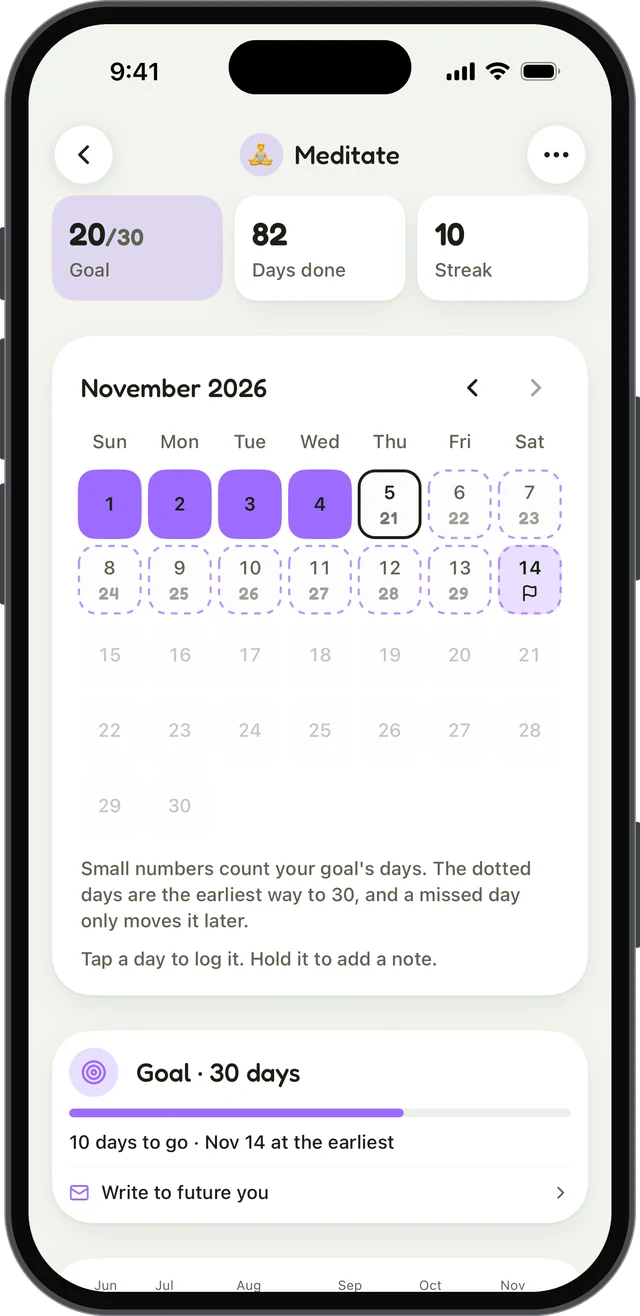
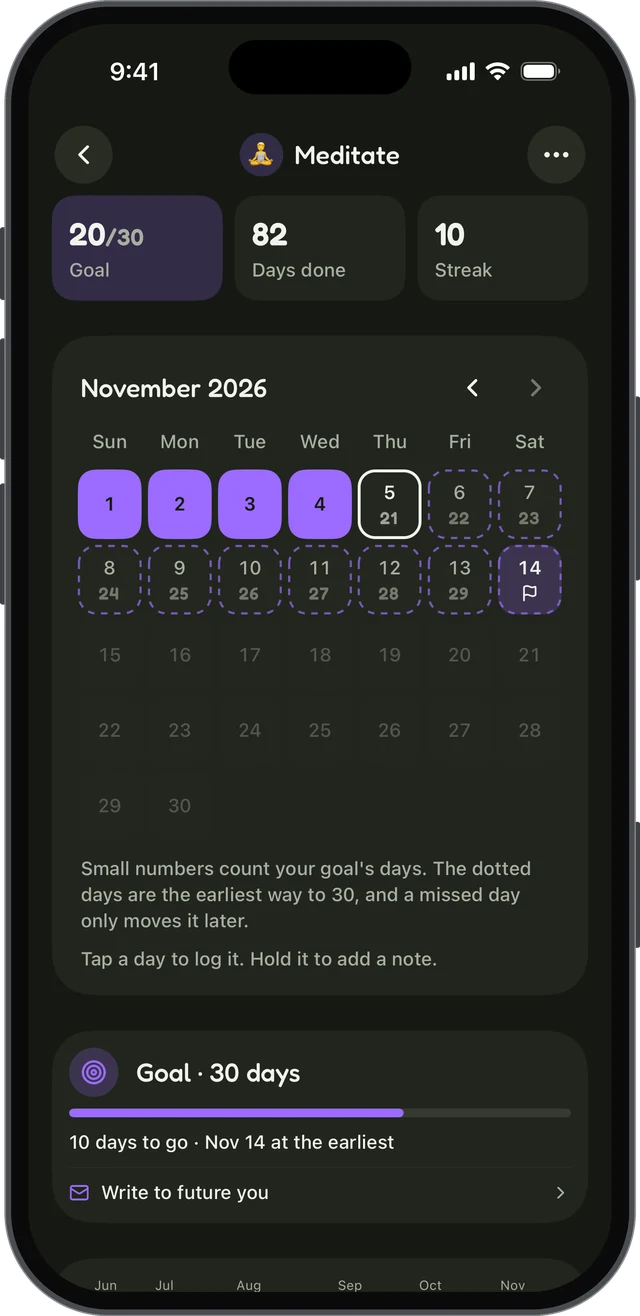
The important part is that the goal only counts up. A missed day never takes days away. It just moves your finish a little later, which is how habit formation actually works: one missed day doesn’t undo the ones before it.
While you work toward it, you can write a letter to yourself that stays sealed until the day you get there. It’s a small thing, but having someone waiting at day 66, even if it’s you, helps on the days when the habit still feels like work. Our guide on writing a letter to your future self has prompts if you want to try it.
The short version
- It takes a median of 66 days to form a habit, not 21.
- Your time could be anywhere from 18 to 254 days. Simple habits are quicker.
- One missed day doesn’t reset anything. Pick it up again the next day. Here’s what to do after a missed day.
- Plan for two months, start small, tie it to a cue, and track it.
If you’re choosing what to start with, our list of habits to track has ideas for every part of the day.
Sources
- Lally, P., van Jaarsveld, C. H. M., Potts, H. W. W., & Wardle, J. (2010). How are habits formed: Modelling habit formation in the real world. European Journal of Social Psychology, 40(6), 998–1009.
- Singh, B., Murphy, A., Maher, C., & Smith, A. E. (2024). Time to form a habit: A systematic review and meta-analysis of health behaviour habit formation and its determinants. Healthcare, 12(23), 2488.
- Maltz, M. (1960). Psycho-Cybernetics. Prentice-Hall.
Questions
How long does it take to form a habit?
In the best-known study, it took a median of 66 days for a daily behaviour to become automatic, with a range from 18 to 254 days depending on the person and the habit. A 2024 review of the research found medians of about two months as well.
Is it true that it takes 21 days to form a habit?
No. The 21-day figure comes from a 1960 self-help book, Psycho-Cybernetics, which said it takes a minimum of about 21 days to get used to a change. Studies that measured habits since then found most take much longer.
Does missing a day reset a habit?
No. In the 66-day study, missing a single day did not noticeably slow habit formation. What matters is getting back to it the next time.
Why do some habits form faster than others?
Simple actions in a steady context, like drinking a glass of water with lunch, become automatic sooner than demanding ones like exercise. How often you repeat it, and whether it’s tied to the same cue each time, matter too.
Keep reading
- Habit science
Missed a Day? Why It Doesn’t Break Your Habit
Missing one day doesn’t undo a habit, and research backs that up. What actually matters is the next day. Here’s how to pick it back up without starting over. - Apps
Best Habit Tracker App for Android: 8 Options, Checked
The best habit tracker app for Android depends on what you need: free, no ads, no account, Wear OS or a game. Eight apps checked on their own pages. - Apps
Best Habitica Alternatives: 7 Habit Trackers, Checked
The best Habitica alternatives, whether you want to keep the game or drop it: seven habit trackers checked for platforms, pricing and accounts.