
Guide
How to Write a Letter to Your Future Self (With 25 Prompts)
A letter to your future self is a small, strangely powerful habit tool. Here’s how to write one, when to open it, and 25 prompts to get you started.

There’s a person who will be you in two months: the one who kept going, who has 66 days of reading, running or sobriety behind them. You can’t meet them yet, but you can write to them.
A letter to your future self sounds sentimental, and it is a little. It’s also one of the simplest ways to make a long goal feel personal. Here’s how to write one, when to open it, and what to put in it.
Why write to your future self?
Most of us treat our future selves a bit like strangers. Psychologist Hal Hershfield and his colleagues have studied this as future self-continuity: how connected you feel to the person you’ll be later. Their research suggests that people who feel closer to their future selves are more willing to make choices that help those future selves, like saving money or sticking to a plan.
A letter is a small, practical way to build that connection. Writing it, you picture the person who gets there. Reading it, they meet the person who started. Both sides of that are motivating.
It also helps on the hard days in the middle. Knowing there’s a sealed letter waiting at the finish gives the goal an ending you’re curious about.
How to write a letter to your future self
- Pick when it opens. A date (your birthday, New Year, a year from now) or a milestone (the day you reach 30 days of a habit). A milestone ties the letter to something you did.
- Start with today. Where are you, what’s your day like, what’s on your mind? The ordinary details are what future you will have forgotten, and what will make the letter land.
- Say why you’re starting. What made you decide now? What do you want to be different?
- Be honest about what’s hard. What are you worried about? What’s likely to get in the way?
- Talk to them, not about them. Write “you”, as you would to a friend: “If you’re reading this, you did it.”
- Seal it and let it be. The letter works best if you don’t reread it along the way. The surprise is part of the reward.
25 prompts for a letter to your future self
If you don’t know where to start, pick two or three of these.
About why you’re starting
- I started because…
- The moment I decided to do this was…
- What I want to be different in my life is…
- I’m doing this for…
- The thing I’m most tired of is…
About right now
- Today, my day looks like…
- Right now I’m worried that…
- Something I’m looking forward to this month is…
- The people around me right now are…
- A small thing that made me happy this week was…
About the change you hope for
- The change I hope for is…
- When I reach this goal, I hope I feel…
- I hope by now you’ve stopped…
- I hope by now you’ve started…
- If it didn’t go to plan, I want you to know…
About what you’re proud of
- I’m proud of myself because…
- Something I did today that I didn’t think I could was…
- A habit I already have that I’m glad about is…
- The hardest day so far was…, and I got through it by…
- One thing I’ve learned about myself is…
About the future
- A question I want you to answer is…
- Something I want you to remember is…
- When you read this, please go and…
- If you could tell me one thing, I think it would be…
- The next goal I hope you set is…
Open it when you reach your goal
The best moment to open a letter like this is the day you reach the thing you wrote it for. That’s how letters work in habitual: when you set a goal, like 30 or 66 days of a habit, you can write a letter to the person who gets there.
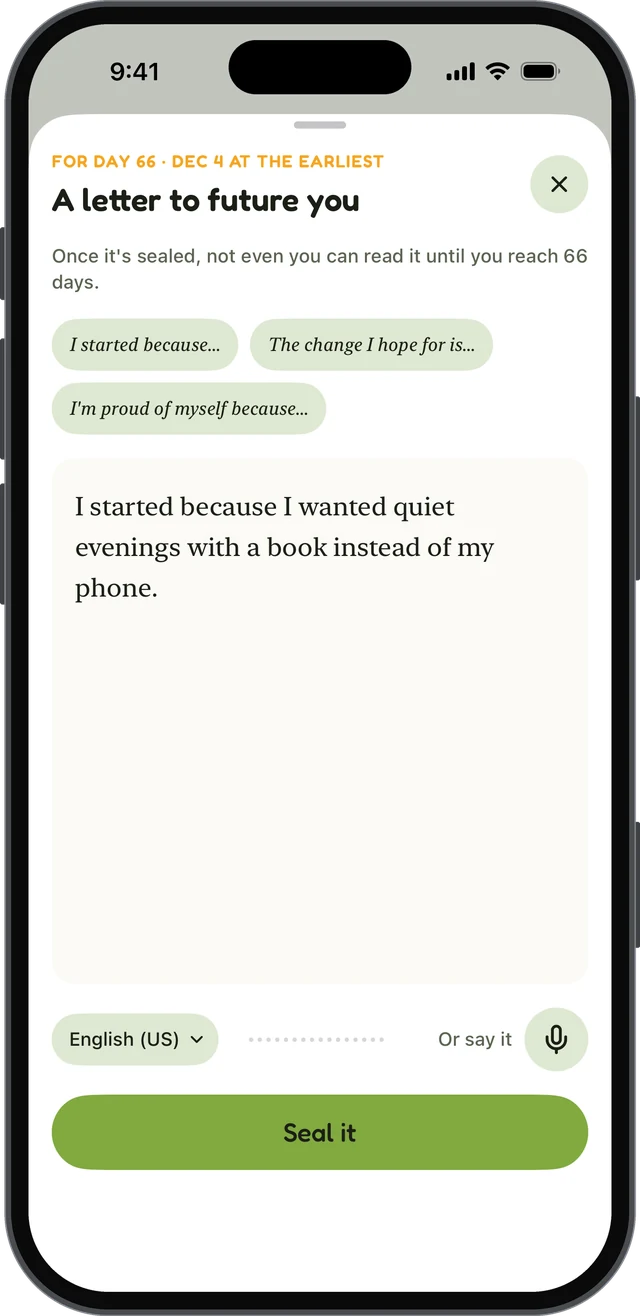
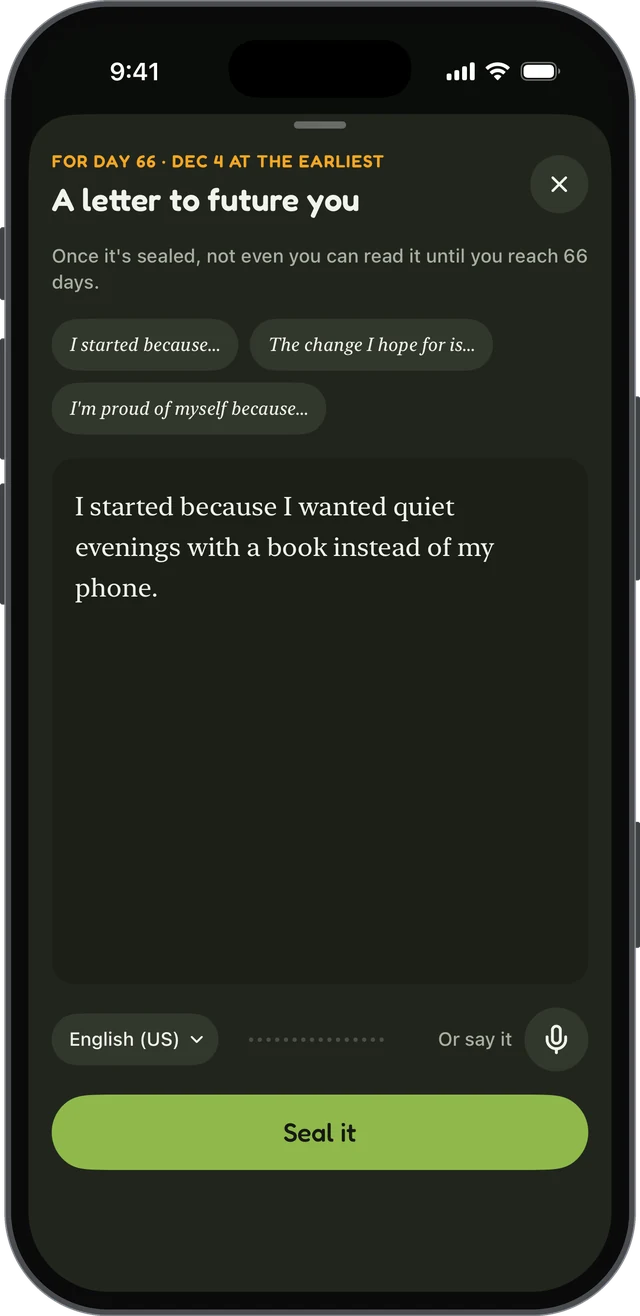
Once it’s sealed, not even you can read it until the goal is reached, and then it opens. There are prompts like the ones above if you get stuck, and you can say your letter out loud instead of typing it.
Because a goal in habitual only counts up, a missed day never takes you further from your letter. It only moves the day you’ll open it a little later.
Tips for a letter worth opening
- Write it on a normal day, not only on a big one. The ordinary details are the most surprising to read later.
- Keep it kind. Future you might not have done everything perfectly. Write the letter you’d want to receive either way.
- Don’t overthink it. Three honest sentences are enough. You can write another one for the next goal.
- Make it a habit. One letter per goal turns each goal into a small chapter of your story.
The short version
- A letter to your future self makes a long goal feel personal and gives it an ending to look forward to.
- Write about today, why you’re starting, what’s hard and what you hope for.
- Open it at a milestone, ideally the day you reach your goal.
- Use the prompts above if you’re stuck, and keep it short if you like.
If your goal is a new habit, it helps to know how long it really takes to form one.
Sources
- Hershfield, H. E. (2011). Future self-continuity: How conceptions of the future self transform intertemporal choice. Annals of the New York Academy of Sciences, 1235, 30–43.
Questions
What should I write in a letter to my future self?
Write about why you’re starting, what you hope will change, what’s hard right now, and what you want to remember. Be specific about today: where you are, what you’re worried about, what you’re proud of. The details are what make it moving to read later.
When should I open a letter to my future self?
Pick a moment that means something: the end of a goal, a birthday, a year from today. Opening it when you reach a goal turns the letter into a reward that’s waiting for you.
How long should a letter to your future self be?
As long as you like. A few honest sentences are enough. A short letter you actually write beats a long one you never start.
Why write a letter to your future self?
It makes your future self feel more real. Research on future self-continuity suggests that people who feel connected to their future selves are more likely to make choices that help them later.
Keep reading
- Guide
How to Stay Consistent: 8 Ways That Don’t Need Motivation
How to stay consistent when motivation fades: eight research-backed ways to keep a habit going, plan for missed days and count your progress. - Guide
Habits for Better Sleep: 9 That Work and How to Keep Them
Nine habits for better sleep, from a fixed wake time to a caffeine cut-off, what the research says about each, and how to make them stick. - Guide
How to Break a Bad Habit: 7 Steps That Work (With Research)
How to break a bad habit for good: find the cue, change your surroundings, plan a replacement and watch for slips. Seven steps, each backed by research.