

Guide
How to Stay Consistent: 8 Ways That Don’t Need Motivation
How to stay consistent when motivation fades: eight research-backed ways to keep a habit going, plan for missed days and count your progress.

How to stay consistent comes down to setup more than willpower: make the habit small enough to do on your worst day, decide exactly when and where you’ll do it, and plan for the days you miss.
That’s good news, because setup is something you can change tonight. Below are eight ways to stay consistent with habits, each with the research behind it and something concrete to try.
Why staying consistent is so hard
If you’ve started the same habit five times, it isn’t a character flaw. Three things work against almost everyone.
The reward comes later, the effort comes now. You exercise for your health in ten years, but the cost is this evening. In a series of five studies, Woolley and Fishbach found that immediate rewards, such as enjoying the activity, predicted whether people kept going with goals like New Year’s resolutions, exercise and studying better than the delayed rewards they said they were pursuing.
Habits get planned for good days. A 45-minute workout fits a quiet Tuesday. It doesn’t fit a day with a sick child or a late train, and that’s the day the pattern breaks.
One slip feels like failure. If you think of consistency as an unbroken chain, a single gap looks like the whole thing has gone. That feeling, more than the missed day itself, is what makes people stop.
How to stay consistent with habits: 8 ways that work
1. Make the habit small enough for your worst day
Set the habit at a size you could manage tired, busy or unwell. Two minutes of stretching. One page. One glass of water before coffee. You can always do more on a good day; the small version is the floor, not the ceiling.
This isn’t only common sense. In a study that followed 111 new gym members for 12 weeks, Kaushal and Rhodes found that exercising consistently and keeping the routine simple both predicted how an exercise habit developed over time, along with the setting and how enjoyable people found it.
Try this: write two versions of your habit, a normal one and a “bad day” one. “Run 5 km” and “put on running shoes and walk to the end of the road”.
2. Decide exactly when and where
“I’ll meditate more” is a wish. “After I pour my morning coffee, I’ll sit at the kitchen table and meditate for three minutes” is a plan. Psychologists call this an implementation intention: an if-then plan that links a situation to an action.
A meta-analysis of 94 independent tests by Gollwitzer and Sheeran found that forming implementation intentions had a medium-to-large positive effect on reaching goals. The plan does some of the deciding for you, so there’s less to negotiate in the moment.
Try this: finish the sentence “When [situation], I will [habit] at [place].” Be specific about the cue, not just the time.
3. Tie it to the same cue every day
A habit forms when the same action happens in the same situation again and again, until the situation starts the action for you. In the best-known study of habit formation, Lally and colleagues asked 96 volunteers to do one behaviour daily in a fixed context, such as “after breakfast”. People who did it more consistently showed a rise in automaticity that more closely followed the typical habit-formation curve.
The easiest cues are things you already do every day without fail: brushing your teeth, making coffee, sitting down on the train. If you want ideas for chaining one habit to another, our guide to habit stacking, with 30 examples, has plenty.
Try this: list five things you do every single day. Pick the one that happens just before the moment your new habit should start.
4. Make it enjoyable now, not just worth it later
Since immediate rewards seem to drive persistence, build some into the habit itself. Choose the kind of exercise you like, not the one that burns the most. Study somewhere pleasant. Pair the habit with something you look forward to.
One version of this is temptation bundling: allowing yourself a treat only while doing the habit. In a field experiment, Milkman, Minson and Volpp gave gym-goers audiobooks they could only listen to at the gym. At first those participants went 51% more often than the control group, though the effect faded over time, especially after the Thanksgiving holiday. It’s a useful boost, not a permanent fix.
Try this: pick one podcast, playlist or audiobook that you only allow yourself during the habit.
5. Track it where you can see it
Writing down what you did is well supported by research. A meta-analysis of 138 studies with nearly 20,000 participants by Harkin and colleagues found that interventions that got people to monitor their progress more often helped them reach their goals. The effect was larger when progress was physically recorded, or reported to someone else or made public.
Part of the appeal is that tracking makes progress visible. A row of ticks is evidence that you’re someone who does this, and it’s easier to protect something you can see.
Try this: track only the habits you’re actively building, and log them as soon as you do them. Paper works well; our free printable habit tracker is made for this. If you’d rather use your phone, habitual is a habit tracker that keeps everything on your device, with no account.
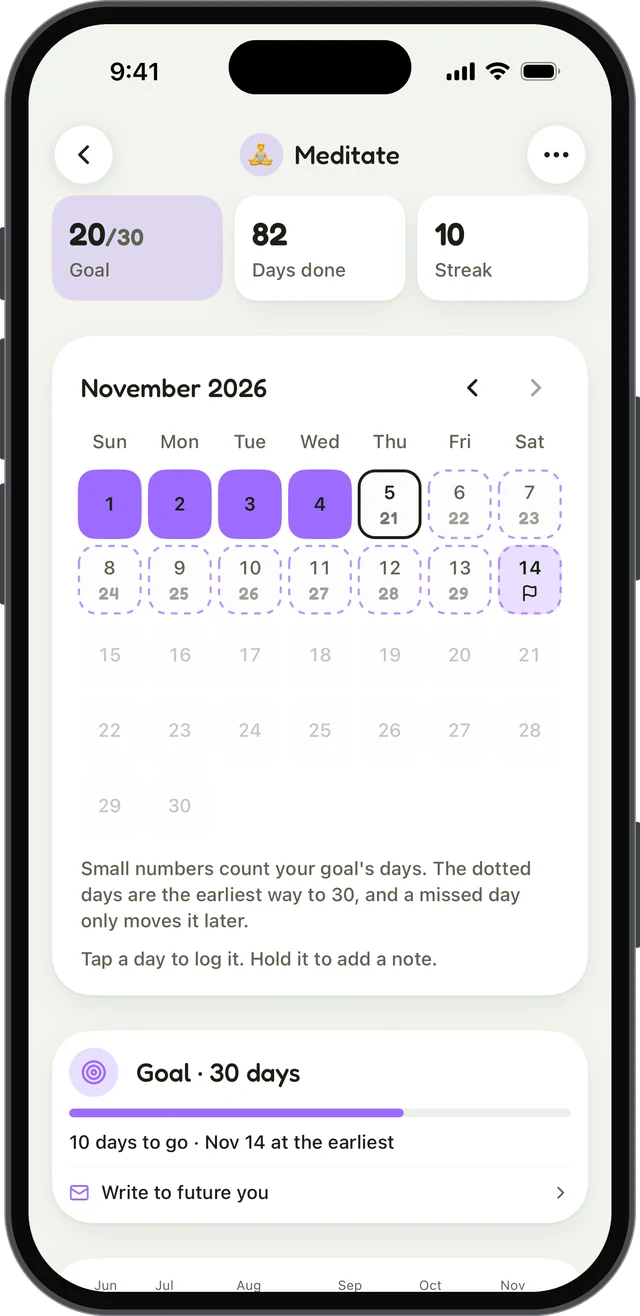
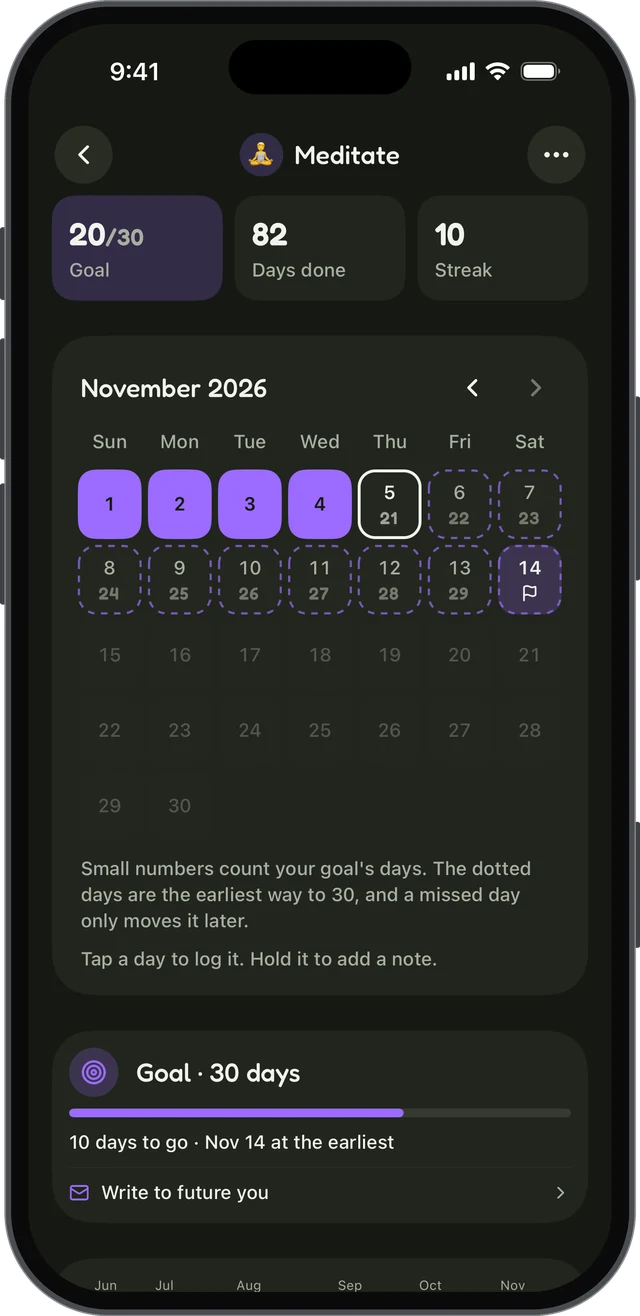
6. Plan for missed days before they happen
You will miss days. Everybody does. The question is what happens next, and it helps to decide that now, not on the day.
The same study by Lally and colleagues found that missing one opportunity to do the behaviour did not materially affect the habit forming. One missed day is not the problem. A run of missed days is, because the habit stops being linked to its cue.
That’s where the rule “never miss twice” comes from. Treat the day after a miss as the important one, and use your bad-day version from step 1 if you need to. We go deeper on this in what to do after a missed day.
7. Count days done, not just days in a row
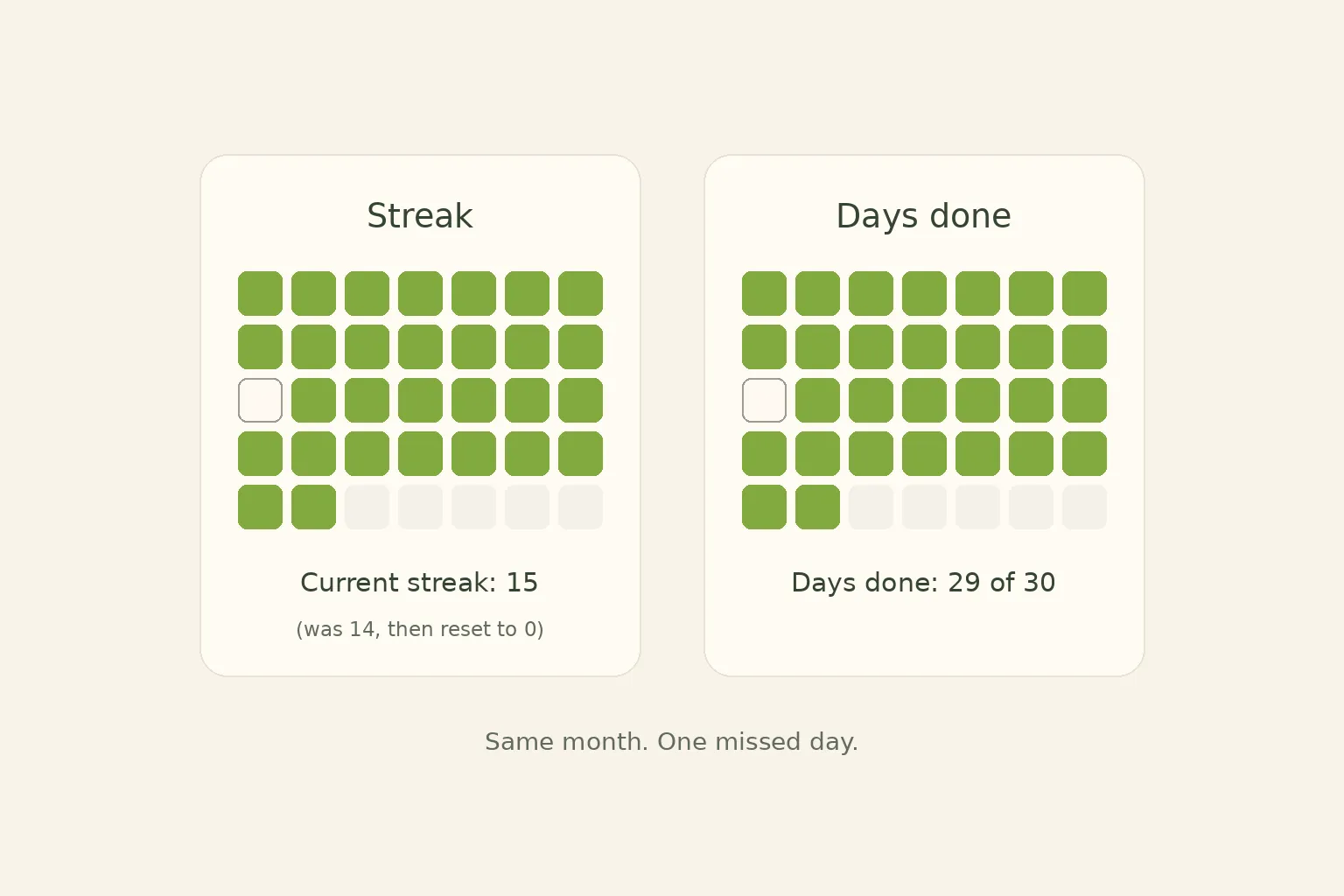
A streak counter treats day 31 after a miss as if days 1 to 30 never happened. That’s motivating while it lasts and discouraging the moment it breaks.
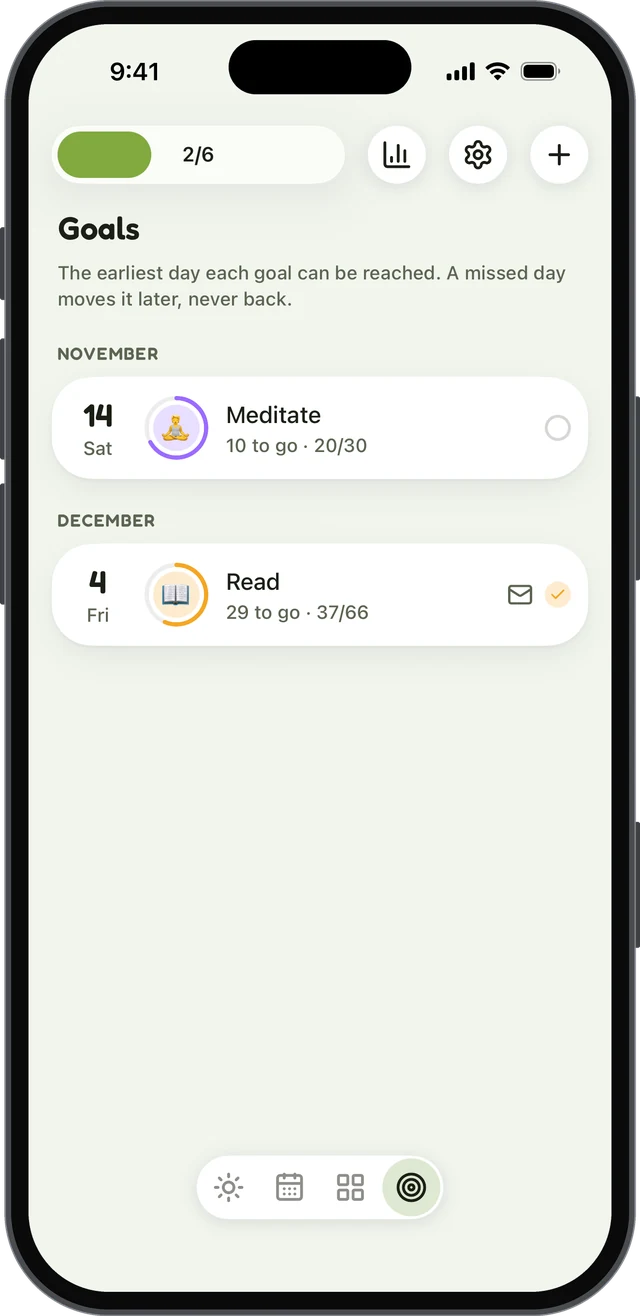
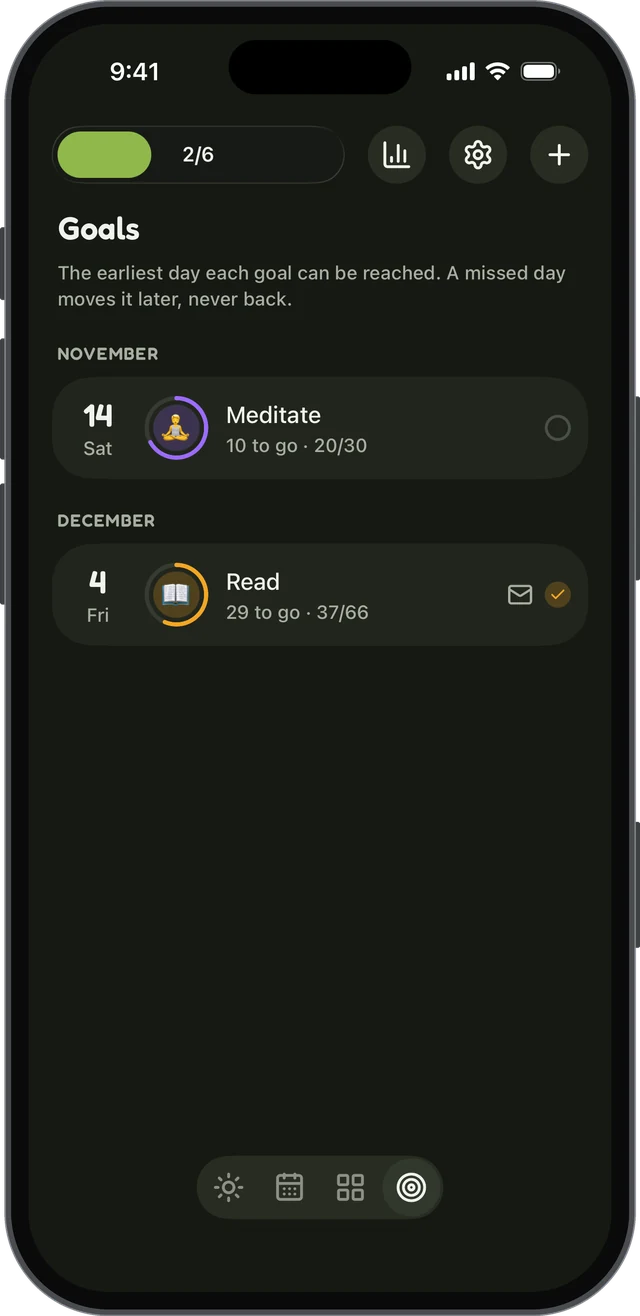
A steadier measure is the total: 26 days out of 30 is a very good month. This is how goals work in habitual. You pick a number of days, like 30 or 66, and every day you do the habit counts towards it. A missed day never takes days back; it only moves the earliest finish date a little later. You can also count days you’ve already done as a head start.
8. Give it longer than you think
It’s tempting to give up on a habit because it doesn’t feel easy yet. That can take a while. In Lally’s study, the time it took people to reach their peak level of automaticity ranged from 18 to 254 days. In Kaushal and Rhodes’s study of gym members, exercising at least four times a week for six weeks was the minimum needed for an exercise habit to form.
So if a habit still feels like effort after three weeks, that’s normal, not a sign it isn’t working. Our post on how long it takes to form a habit explains why the answer isn’t 21 days.
How to stay consistent when motivation is low
Motivation comes and goes; the setup is what carries you through. On a low day, run through this:
Doubling up after a miss feels responsible, but it turns the habit into a bigger task, and bigger tasks are the ones that get skipped.
A one-week plan to get consistent
If you’re starting again, start small. Here’s a simple week:
- Day 1: Choose one habit. Write its normal version and its bad-day version.
- Day 1: Write your when-and-where plan: “When [situation], I will [habit] at [place].”
- Day 2: Add one immediate reward, like a playlist you only play during it.
- Days 2 to 7: Do it at the cue every day, and log it straight away.
- Day 7: Look at the week. If you missed days, look at why: the time, the cue or the size. Change one thing.
Then do the same next week. Add a second habit only when the first one feels like part of the day. If you’re choosing what to work on, our guide on how to build a habit that sticks walks through picking the right first habit.
The short version
- Make the habit small enough for your worst day.
- Decide exactly when and where, and tie it to a cue you already have.
- Make it enjoyable now, not only worth it later.
- Track it, and count days done, not only days in a row.
- Expect missed days, and never miss twice.
- Give it weeks, not days.
Sources
- Gollwitzer, P. M., & Sheeran, P. (2006). Implementation intentions and goal achievement: A meta-analysis of effects and processes. Advances in Experimental Social Psychology, 38, 69–119.
- Harkin, B., Webb, T. L., Chang, B. P. I., Prestwich, A., Conner, M., Kellar, I., Benn, Y., & Sheeran, P. (2016). Does monitoring goal progress promote goal attainment? A meta-analysis of the experimental evidence. Psychological Bulletin, 142(2), 198–229.
- Kaushal, N., & Rhodes, R. E. (2015). Exercise habit formation in new gym members: A longitudinal study. Journal of Behavioral Medicine, 38(4), 652–663.
- Lally, P., van Jaarsveld, C. H. M., Potts, H. W. W., & Wardle, J. (2010). How are habits formed: Modelling habit formation in the real world. European Journal of Social Psychology, 40(6), 998–1009.
- Milkman, K. L., Minson, J. A., & Volpp, K. G. M. (2014). Holding the Hunger Games hostage at the gym: An evaluation of temptation bundling. Management Science, 60(2), 283–299.
- Woolley, K., & Fishbach, A. (2017). Immediate rewards predict adherence to long-term goals. Personality and Social Psychology Bulletin, 43(2), 151–162.
Questions
Why is it so hard to stay consistent?
Most habits pay off later, but the effort is today, and research suggests that what you enjoy now predicts whether you keep going better than the benefits you expect later. Habits also tend to be planned for good days, so the first busy or tired day breaks the pattern. Making the habit smaller, tying it to a fixed cue and making it more enjoyable all help.
How do I stay consistent when I have no motivation?
Don’t rely on motivation. Decide in advance exactly when and where you’ll do the habit, and keep a tiny version ready for low days, like one page instead of a chapter. The aim on those days is to keep the habit linked to its cue, not to make progress.
How long does it take to become consistent?
Longer than most people expect. In a study of 96 people building a daily habit, the time it took to reach their peak level of automaticity ranged from 18 to 254 days. A study of new gym members found that exercising at least four times a week for six weeks was the minimum for an exercise habit to form.
Does missing one day ruin consistency?
No. In the same study of 96 people, missing a single opportunity did not materially affect how the habit formed. What matters is getting back to it at the next chance, which is why many people use the rule “never miss twice”.
Keep reading
- Guide
Habits for Better Sleep: 9 That Work and How to Keep Them
Nine habits for better sleep, from a fixed wake time to a caffeine cut-off, what the research says about each, and how to make them stick. - Guide
How to Break a Bad Habit: 7 Steps That Work (With Research)
How to break a bad habit for good: find the cue, change your surroundings, plan a replacement and watch for slips. Seven steps, each backed by research. - Guide
Habit Stacking: How to Use It (With 30 Examples)
Habit stacking ties a new habit to one you already do. Here’s the formula, what research says about it, how to pick an anchor, and 30 examples.