
Guide
Habit Stacking: How to Use It (With 30 Examples)
Habit stacking ties a new habit to one you already do. Here’s the formula, what research says about it, how to pick an anchor, and 30 examples.
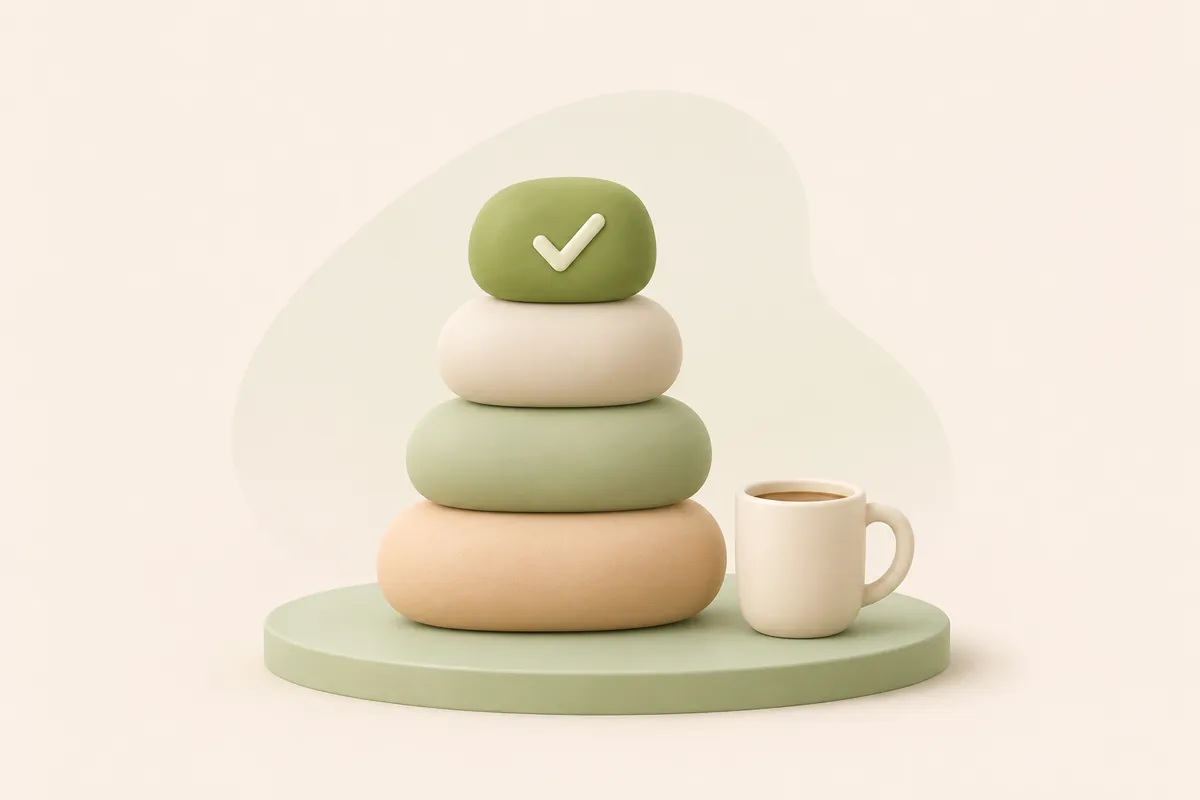
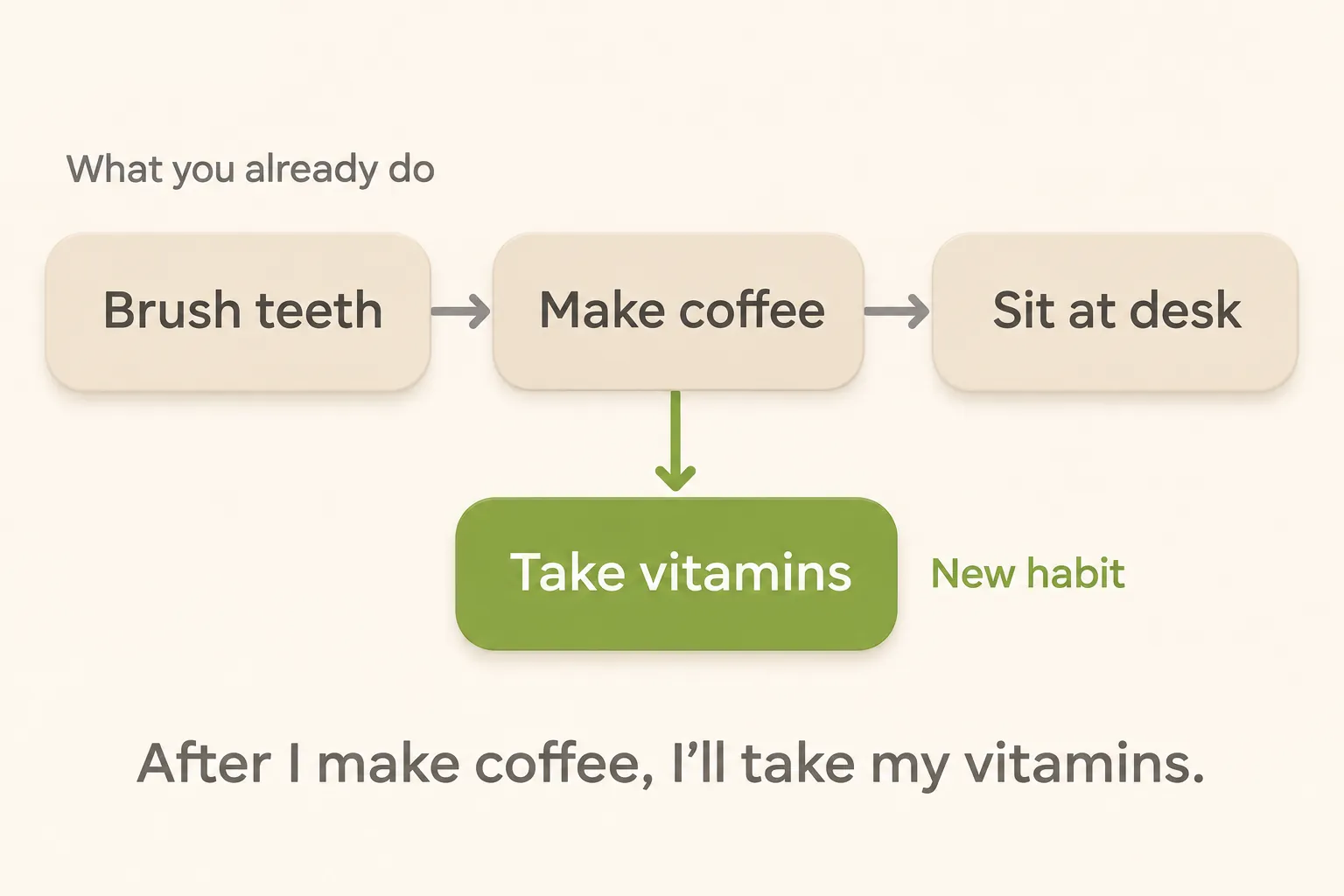
Habit stacking is a simple way to start a new habit: you tie it to something you already do every day. “After I pour my morning coffee, I’ll take my vitamins.” The coffee is the reminder, so you don’t have to remember anything.
This guide covers the habit stacking formula, what the research says about why it works, how to choose a good anchor, the mistakes that make stacks fall apart, and 30 examples you can copy.
What is habit stacking?
A habit is a behaviour that starts almost by itself when a cue appears. Psychologists who study habits describe them as something learnt through repetition in a consistent context: do the same thing after the same cue often enough, and the cue starts to trigger it.
The hard part of a new habit is that it has no cue yet. Habit stacking borrows one. Your day is already full of things you do without thinking (making coffee, brushing your teeth, sitting down at your desk), and each of them can become the cue for something new.
The name is usually credited to S.J. Scott’s book Habit Stacking, and James Clear made it popular in Atomic Habits. BJ Fogg describes the same idea in Tiny Habits, where the existing habit is called an anchor. We’ll use that word here.
The habit stacking formula
The formula is one sentence:
After I [current habit], I will [new habit].
Some examples:
- After I pour my morning coffee, I will write down my one most important task.
- After I sit down on the train, I will read five pages.
- After I brush my teeth at night, I will floss.
You can also use “Before I…” when the new habit has to come first: “Before I open my laptop, I will drink a glass of water.”
Why writing the sentence matters
The formula is a form of what psychologists call an implementation intention: a plan in the shape “When X happens, I will do Y.” In a review of 94 studies, Peter Gollwitzer and Paschal Sheeran found that plans like this had a medium-to-large effect on whether people followed through on their goals. Deciding the cue in advance means there’s nothing left to decide in the moment.
Habit researchers at University College London recommend the same approach for patients. In their advice for doctors on habit formation, Benjamin Gardner, Phillippa Lally and Jane Wardle suggest picking a cue inside an existing daily routine, such as “after breakfast”, and give the sample plan “after I have lunch at home I will have a piece of fruit”.
Does habit stacking work? What the research says
There’s little research on habit stacking under that name, but one small study tested exactly the question it raises: does it matter where in your routine you put the new habit?
In a study of 50 people learning to floss, Gaby Judah and colleagues told half the group to floss before brushing their teeth and half to floss after. Everyone reported their flossing daily. The people who flossed after brushing tended to form stronger flossing habits, and eight months later they had stronger habits and flossed more often.
It was an exploratory study with a small group, so it isn’t proof. But it suggests something useful: a new habit placed straight after an established one, at the natural end of a routine, may stick better than one squeezed in before it.
Stacking still doesn’t skip the slow part. In the best-known study of habit formation, 96 people repeated one new behaviour daily, and it took a median of 66 days to feel automatic, with a range from 18 to 254. A good anchor makes those repetitions easier to get, but you still need them. More on that in how long it takes to form a habit.
How to habit stack in 5 steps
1. List what you already do every day
Write down the things you do daily without fail, in order. Most people find 10 to 15 within a few minutes:
Also list things that happen to you: the kettle boils, a meeting ends, the train arrives.
2. Pick the right anchor
A good anchor has three qualities:
- It happens every time you want the new habit to happen. A daily habit needs a daily anchor. “After my Saturday run” only works for a weekly habit.
- It’s specific. “After I put my cup in the sink” is a clear moment. “In the morning” or “after lunch break” is a stretch of time, and easy to miss.
- It fits the new habit. Stack meditation on a quiet moment, not on the school run. Stack flossing in the bathroom, where the floss is.
3. Make the new habit tiny
The new habit should take a minute or two at first: one push-up, one line in a journal, one page. You can grow it once it’s automatic. A big habit on a good anchor still fails on a tired day.
4. Write the sentence and put the cue in sight
Write the full sentence down. Then make the link physical: the vitamins next to the kettle, the book on your pillow, the floss next to the toothbrush.
5. Track the new habit, not the anchor
You don’t need to track the coffee; it’s happening anyway. Track the new habit, so you can see whether the stack is working. A meta-analysis of 138 studies by Benjamin Harkin and colleagues found that monitoring your progress helps you reach a goal, and helps more when you physically record it.
If you track and see the same gaps every week, the anchor is the problem, not you. Try a different one. Our guide on how to stay consistent has more ways to keep a habit going, including what to do after a missed day.
30 habit stacking examples
Pick one. Copy the sentence, or change the anchor to one that fits your day.
Morning routine
- After I turn off my alarm, I’ll drink the glass of water on my bedside table.
- After I get out of bed, I’ll make it.
- After I start the kettle, I’ll stretch until it boils.
- After I pour my coffee, I’ll take my vitamins.
- After I sit down with my coffee, I’ll write my one most important task for today.
- After I brush my teeth, I’ll do 10 squats.
- After I get dressed, I’ll put my phone on charge in another room until breakfast is done.
- After I put on my shoes, I’ll check that I have my water bottle.
Work and study
- After I sit down at my desk, I’ll close every tab I don’t need.
- After I open my laptop, I’ll check today’s calendar before email.
- After every meeting, I’ll write down the next step while it’s fresh.
- After I finish lunch, I’ll walk for 10 minutes.
- After I close my last lecture notes, I’ll test myself for 5 minutes.
- After I shut my laptop for the day, I’ll write tomorrow’s first task on a sticky note.
Health and movement
- After I fill my water bottle, I’ll drink half of it before I sit down.
- After I get off the bus, I’ll take the stairs instead of the lift.
- After I take off my work shoes, I’ll put on my running shoes (even if I only walk).
- After I sit down to watch TV, I’ll stretch for the first 5 minutes.
- After I take my evening medicine, I’ll fill in my blood pressure reading.
- After I brush my teeth at night, I’ll floss.
Home and money
- After I finish dinner, I’ll wipe the kitchen counter.
- After I get home, I’ll put my keys in the same bowl.
- After I take off my coat, I’ll hang it up instead of putting it on a chair.
- After I pay for something, I’ll note it in my spending list.
- After the kettle goes on in the evening, I’ll empty the dishwasher.
Calm, sleep and relationships
- After I get into bed, I’ll write one line about my day.
- After I turn off the light, I’ll take five slow breaths.
- After I sit down to eat, I’ll ask whoever I’m with one question about their day.
- After I make my Sunday coffee, I’ll message one friend or family member.
- After I plug in my phone at night, I’ll leave it there until morning.
Looking for more habits to stack? Our list of 60 habits to track has ideas for every part of the day, and our morning routine ideas include ready-made routines of 5, 15 and 30 minutes.
Habit stacking mistakes to avoid
Stacking too much at once
It’s tempting to build a whole new morning routine on day one. Don’t. Each new habit needs its own repetitions, and a chain of five new habits is five things to forget. Add one, wait until it happens without effort, then add the next.
A long chain with a weak link
Once several habits are stacked in a row, each one becomes the cue for the next. That’s the strength of a routine and its weakness: miss one link and everything after it tends to go too. Keep chains short, and make the first habit after the anchor the most important one.
An anchor that doesn’t always happen
If you only make coffee on workdays, your coffee-based habits will vanish at weekends. Either pick an anchor that happens every day you want the habit, or set a second anchor for the other days (“After I make my weekend tea…”).
Losing the anchor
Holidays, a new job, a new baby: when your routine changes, your anchors can disappear without you noticing, and the habits go with them. When life changes, re-attach your habits to new anchors on purpose. If a habit has already slipped, read what to do after a missed day.
Using habit stacking to quit a habit
Stacking works for breaking habits too, as a swap. Many unwanted habits already have a reliable cue. Keep the cue, change what follows:
- After I get into bed, I’ll read instead of scrolling (the phone charges across the room).
- After I finish dinner, I’ll make a cup of tea instead of opening the snack cupboard.
- After I feel the urge to check my phone at my desk, I’ll stand up and refill my water.
Count the days you stay on track. That makes the swap visible, and seeing a growing number of good days is a reason to keep going. For the full method, from finding the cue to planning for slips, see our guide on how to break a bad habit.
Track your stack
Paper works: write your stack sentence at the top of our free printable habit tracker and tick off each day.
On your phone, habitual is a habit tracker that keeps everything on the phone itself, with no account and no ads. Each habit gets its own page and grid of the days you did it, so a gap that repeats every Saturday is easy to spot. A habit can be counted, timed with a built-in timer, or something you’re quitting, and the free version covers up to 3 active habits, which is plenty for your first stack.
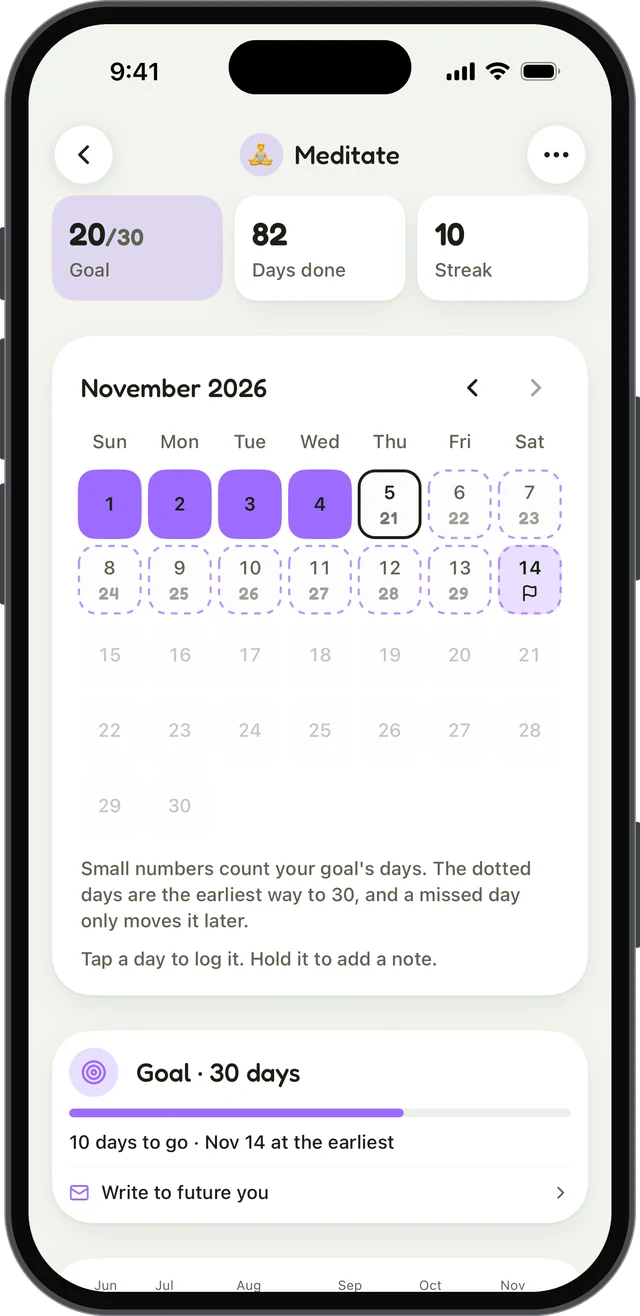
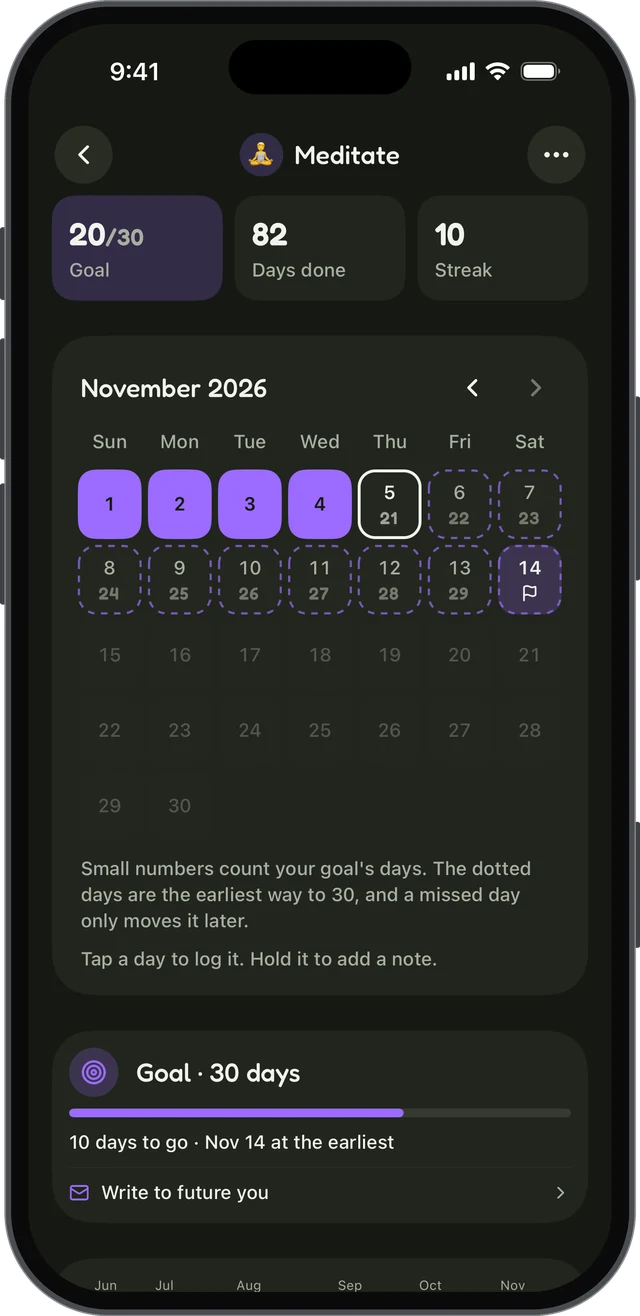
You can also set a goal of, say, 66 days for the new habit. In habitual, goals only count up: a missed day never takes days away, it just moves the earliest finish date a little later. For the rest of the method, from choosing a cue to planning for bad days, see how to build a habit that sticks.
Sources
- Gardner, B., Lally, P., & Wardle, J. (2012). Making health habitual: The psychology of ‘habit-formation’ and general practice. British Journal of General Practice, 62(605), 664–666.
- Gollwitzer, P. M., & Sheeran, P. (2006). Implementation intentions and goal achievement: A meta-analysis of effects and processes. Advances in Experimental Social Psychology, 38, 69–119.
- Harkin, B., Webb, T. L., Chang, B. P. I., Prestwich, A., Conner, M., Kellar, I., Benn, Y., & Sheeran, P. (2016). Does monitoring goal progress promote goal attainment? A meta-analysis of the experimental evidence. Psychological Bulletin, 142(2), 198–229.
- Judah, G., Gardner, B., & Aunger, R. (2013). Forming a flossing habit: An exploratory study of the psychological determinants of habit formation. British Journal of Health Psychology, 18(2), 338–353.
- Lally, P., van Jaarsveld, C. H. M., Potts, H. W. W., & Wardle, J. (2010). How are habits formed: Modelling habit formation in the real world. European Journal of Social Psychology, 40(6), 998–1009.
Questions
What is habit stacking?
Habit stacking means linking a new habit to something you already do every day, so the old habit becomes the reminder for the new one. For example: “After I pour my morning coffee, I’ll take my vitamins.” The existing habit is called the anchor.
What is the habit stacking formula?
The usual formula is “After I [current habit], I will [new habit].” You can also use “Before I…” when the new habit needs to come first. The current habit should be something you do at the same time and place every day.
Does habit stacking work?
There are few studies of habit stacking by that name, but it’s a form of if-then planning, which a review of 94 studies found had a medium-to-large effect on whether people followed through. In one small study, people who flossed straight after brushing their teeth formed stronger flossing habits than those who flossed before.
How many habits can you stack at once?
Start with one new habit on one anchor. Once it happens without much thought, which often takes around two months, you can add another. Long chains are fragile: if one link is missed, everything after it tends to be missed too.
Keep reading
- Guide
How to Stay Consistent: 8 Ways That Don’t Need Motivation
How to stay consistent when motivation fades: eight research-backed ways to keep a habit going, plan for missed days and count your progress. - Guide
Habits for Better Sleep: 9 That Work and How to Keep Them
Nine habits for better sleep, from a fixed wake time to a caffeine cut-off, what the research says about each, and how to make them stick. - Guide
How to Break a Bad Habit: 7 Steps That Work (With Research)
How to break a bad habit for good: find the cue, change your surroundings, plan a replacement and watch for slips. Seven steps, each backed by research.