
Ideas
Morning Routine Ideas: 40 Small Habits and How to Keep Them
40 morning routine ideas, grouped by what they do, plus 5-, 15- and 30-minute routines and what research says about making morning habits stick.

The best morning routine ideas are small and boring: get up at the same time, get some daylight, drink some water, move a little, and spend two minutes deciding what today is for. You don’t need an hour or a 5 am alarm. You need a few steps you do in the same order, every day, until they happen without thinking.
Below are 40 ideas, grouped by what they do, followed by ready-made routines for 5, 15 and 30 minutes and what research says about making a morning routine stick.
Why a morning routine is a good place for habits
A habit is something a cue sets off with little thought. Mornings are full of reliable cues: the alarm, your feet on the floor, the kettle, brushing your teeth. Each one can carry a new habit, which is the idea behind habit stacking.
There’s some evidence that mornings help in their own right. In a 90-day study of 48 students, Marion Fournier and colleagues randomly assigned students to do a simple stretch either straight after waking or before bed. Modelling of their learning curves suggested the morning group would reach automaticity sooner, at around 106 days compared with 154, and the researchers linked the difference to the body’s natural cortisol peak in the morning. It’s one small study with one stretch, and those figures are projections rather than observed finish lines, so don’t take them too literally. But it points the same way as everyday experience: mornings are more predictable than evenings, and predictable is what habits need.
40 morning routine ideas
Pick from these rather than trying to do them all. Most take under five minutes.
Waking up
- Get up at the same time every day, weekends included.
- Put your alarm across the room, so you have to stand up to switch it off.
- Use a plain alarm clock, so your phone isn’t the first thing you touch.
- Open the curtains or blinds as soon as you’re up.
- Make your bed: two minutes, and the room looks finished.
- Wash your face with cold water.
If you snooze, you may not need to stop. In a lab study of 31 regular snoozers, Tina Sundelin and colleagues found that 30 minutes of snoozing cost about 6 minutes of sleep and didn’t harm thinking, mood or sleepiness after getting up. If snoozing makes you rushed, though, a fixed time to stand up is the better habit. For more on getting the night right first, see our guide to habits for better sleep.
Daylight and movement
- Step outside for five minutes: the garden, the balcony, the doorstep.
- Drink your first coffee or tea by a window.
- Walk part of the way to work, school or the bus.
- Stretch for two minutes: neck, shoulders, back, hamstrings.
- Do ten squats or ten push-ups while the kettle boils.
- Follow a ten-minute yoga or mobility video.
- Go for a short run or cycle on the days you have time.
Light reaching your eyes is what keeps your body clock in step with the 24-hour day, as Christine Blume and colleagues explain in a review of light, sleep and mood. A few minutes of morning daylight is an easy way to give it a clear signal.
Water and breakfast
- Drink a glass of water before anything else.
- Keep a glass or bottle by the bed so it’s the first thing you see.
- Eat a breakfast with some protein, such as eggs, yoghurt or beans on toast.
- Prepare overnight oats the evening before.
- Eat breakfast sitting down, not standing at the counter.
- Take any medication or supplements at the same point each morning, such as with breakfast.
Breakfast is a good anchor for other habits, but it isn’t magic. A meta-analysis of 13 randomised trials by Katherine Sievert and colleagues found that eating breakfast didn’t help adults lose weight; if anything, the breakfast groups ate slightly more over the day. Eat breakfast if you’re hungry and it suits you, not because you’ve been told it’s the most important meal.
Calm and focus
- Take five slow breaths before you get out of bed.
- Sit quietly for five minutes, with or without a meditation app.
- Write three lines in a journal: how you slept, how you feel, one thing you’re looking forward to.
- Write down one thing you’re grateful for.
- Read ten pages of a book with your coffee.
- Listen to music or a podcast instead of the news.
- Leave social media until you’ve finished your routine.
Planning the day
- Write today’s three most important tasks.
- Look at your calendar once, so nothing surprises you.
- Decide on the one thing that would make today a good day.
- Check the weather before choosing clothes.
- Block the first hour of work for your hardest task.
- Glance at your habit tracker and tick yesterday’s habits if you missed them.
- Set out what you need for the evening, like gym kit or a dinner plan.
Home and getting out the door
- Empty the dishwasher or put away the dry dishes.
- Open a window to air the room.
- Water the plants.
- Feed the pets before yourself.
- Leave keys, wallet and bag by the door the night before.
- Spend two minutes tidying one surface.
- Say something kind to the people you live with before anyone leaves.
Simple morning routines for 5, 15 and 30 minutes
Here are three ready-made routines built from the list. Each is in a sensible order, so one step leads into the next.
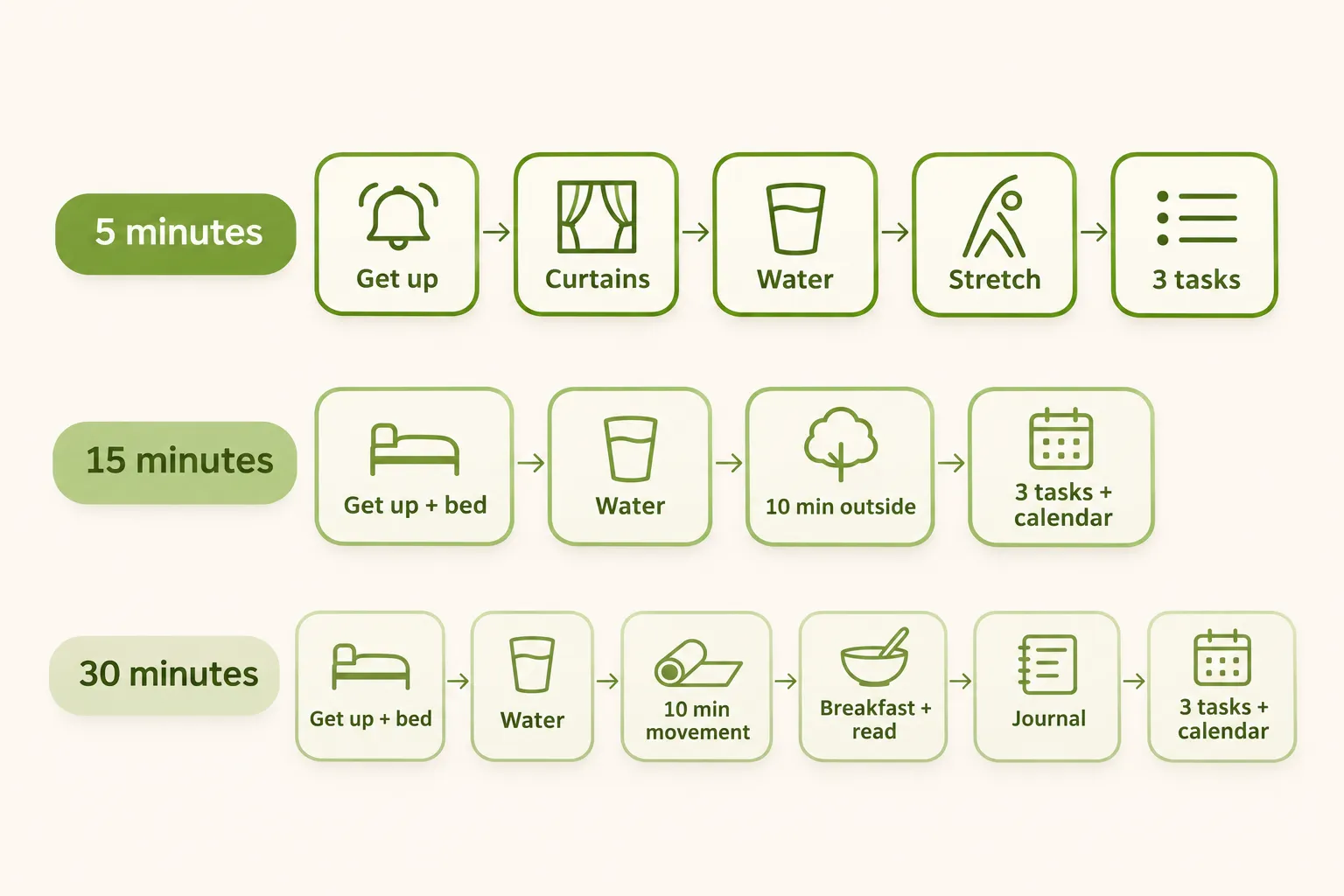
The 5-minute routine
The 15-minute routine
The 30-minute routine
If you’re wondering how long a morning routine should be, the honest answer is: as long as you can keep on a weekday. A five-minute routine done every day does more than a ninety-minute one done twice.
How to build a morning routine that sticks
Most people have tried a morning routine before. The problem usually isn’t the ideas; it’s keeping them past the second week.
Start with three habits
Choose three from the list, not ten. A short routine survives a bad night, a late train and a sick child. Once it feels automatic, add one more.
Tie each step to the one before
Write your routine as a chain: “After I switch off the alarm, I open the curtains. After I open the curtains, I drink a glass of water.” Plans like this, where you decide in advance when and where you’ll act, are called implementation intentions. In a meta-analysis of 94 independent tests, Peter Gollwitzer and Paschal Sheeran found they had a medium-to-large effect on reaching goals.
Keep it in the same order
Habits form through repetition in a consistent context. In a study of 96 people who picked a daily habit, Phillippa Lally and colleagues found it took a median of 66 days to become automatic, with a range from 18 to 254 days. Doing the same steps in the same order every morning gives each one the steadiest possible cue. There’s more on the timescale in how long it takes to form a habit.
Have a short version for bad mornings
Decide now what the minimum is on a day when everything goes wrong: perhaps just the water and the three tasks. Doing the short version keeps the chain going. The same study found that missing one day didn’t materially affect how habits formed, so if a morning falls apart entirely, just pick it up tomorrow.
Track it
Writing down what you did helps you keep doing it. In a meta-analysis of 138 studies with nearly 20,000 participants, Benjamin Harkin and colleagues found that monitoring progress helped people reach their goals, and it helped more when the progress was physically recorded.
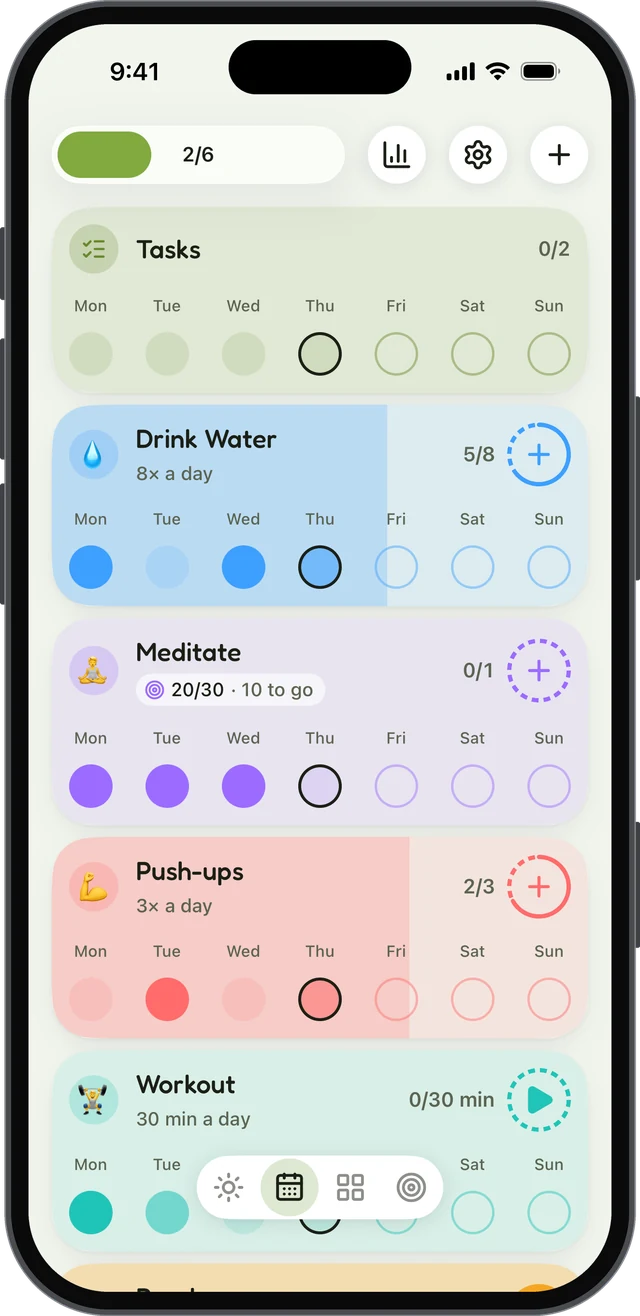
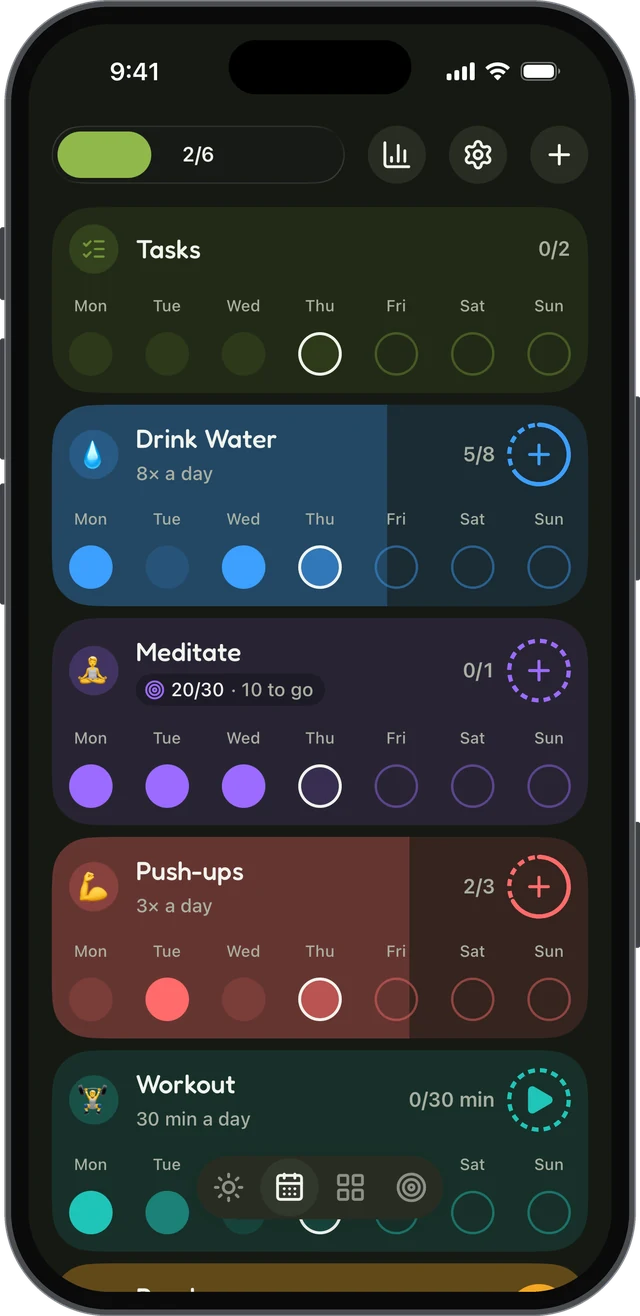
habitual, a habit tracker that keeps everything on your phone, lets you log each morning habit with a tap and see the days you did it on its own grid. You can set a reminder for the time you usually get up, and add a short list of today’s tasks, which suits the planning step. If you’d rather use paper, our free printable daily habit tracker works well on the fridge or next to the kettle.
A sample weekday morning
Here’s what a 15-minute routine looks like in a real morning, with each step tied to the one before:
- 7:00 Alarm across the room. Get up, open the curtains.
- 7:02 Glass of water from the bottle by the bed.
- 7:05 Shoes on, ten minutes around the block.
- 7:15 Kettle on. While it boils, write three tasks on a sticky note.
- 7:20 Breakfast, then on with the day.
Nothing here is new. It’s an ordinary morning with a habit placed at each step, done in the same order until it stops feeling like a routine and starts feeling like how mornings go.
Sources
- Blume, C., Garbazza, C., & Spitschan, M. (2019). Effects of light on human circadian rhythms, sleep and mood. Somnologie, 23(3), 147–156.
- Fournier, M., d’Arripe-Longueville, F., Rovere, C., Easthope, C. S., Schwabe, L., El Methni, J., & Radel, R. (2017). Effects of circadian cortisol on the development of a health habit. Health Psychology, 36(11), 1059–1064.
- Gollwitzer, P. M., & Sheeran, P. (2006). Implementation intentions and goal achievement: A meta-analysis of effects and processes. Advances in Experimental Social Psychology, 38, 69–119.
- Harkin, B., Webb, T. L., Chang, B. P. I., Prestwich, A., Conner, M., Kellar, I., Benn, Y., & Sheeran, P. (2016). Does monitoring goal progress promote goal attainment? A meta-analysis of the experimental evidence. Psychological Bulletin, 142(2), 198–229.
- Lally, P., van Jaarsveld, C. H. M., Potts, H. W. W., & Wardle, J. (2010). How are habits formed: Modelling habit formation in the real world. European Journal of Social Psychology, 40(6), 998–1009.
- Sievert, K., Hussain, S. M., Page, M. J., Wang, Y., Hughes, H. J., Malek, M., & Cicuttini, F. M. (2019). Effect of breakfast on weight and energy intake: Systematic review and meta-analysis of randomised controlled trials. BMJ, 364, l42.
- Sundelin, T., Landry, S., & Axelsson, J. (2024). Is snoozing losing? Why intermittent morning alarms are used and how they affect sleep, cognition, cortisol, and mood. Journal of Sleep Research, 33(3), e14054.
Questions
What is a good morning routine?
A good morning routine is short, done in the same order every day, and built from things you’ll actually keep doing. For most people that means getting up at the same time, some daylight or movement, water or breakfast, and a minute to plan the day. Three to five steps is plenty to start with.
How long should a morning routine be?
There’s no ideal length, and a short routine you keep beats a long one you drop. Five to fifteen minutes is enough for a routine that sticks, and thirty minutes leaves room for exercise or reading. Build it to fit the time you really have on a weekday, not on your best morning.
Is it bad to check your phone first thing in the morning?
It isn’t harmful in itself, but it often takes over the time you meant for something else. If your mornings feel rushed, try leaving the phone on its charger until you’ve done one or two steps of your routine, and use a separate alarm clock so the phone isn’t the first thing you pick up.
Is snoozing your alarm bad for you?
Less than its reputation suggests. In a lab study of 31 regular snoozers, 30 minutes of snoozing cost about 6 minutes of sleep and didn’t harm thinking or mood straight after waking. If snoozing makes you late or rushed, though, it’s worth replacing with a fixed time to get up.
Should a morning routine be the same every day?
The core should be. Habits form when the same action follows the same cue, so doing the same few steps in the same order each morning is what makes them automatic. You can keep a shorter version for busy days and add extras at the weekend.
Keep reading
- Ideas
Healthy Habits for Kids: 45 Ideas and How to Make Them Stick
45 healthy habits for kids, grouped by sleep, food, play, teeth, screens and feelings, with the guidelines behind them and how to make them stick. - Ideas
Self-Care Habits: 50 Small Ideas and How to Make Them Stick
50 self-care habits for body, mind and the people around you, the research behind the ones that matter most, and how to choose three you’ll keep. - Ideas
Good Habits for Students: 40 Ideas Backed by Research
40 good habits for students, from study and sleep to phones and money, plus what research says works and how to start with just three.