
Ideas
Healthy Habits for Kids: 45 Ideas and How to Make Them Stick
45 healthy habits for kids, grouped by sleep, food, play, teeth, screens and feelings, with the guidelines behind them and how to make them stick.
Healthy habits for kids come down to a short list: enough sleep at regular times, food eaten together, an hour of active play, clean hands and teeth, sensible screen limits, and a way to talk about big feelings. Below are 45 ideas, grouped by area, with the guidelines behind the ones that matter most.
You don’t need all 45. Near the end there’s a way to choose your first few, and a sample day that shows what they look like at home.
What makes a habit stick for a child
A habit is something you do with little thought because a cue starts it: a time, a place, or something that happens just before. Psychologists Benjamin Gardner, Phillippa Lally and Jane Wardle describe the recipe in a short review for family doctors: repeat one simple action in the same situation every day, and over time the situation alone starts the action.
That suits children well, because their days are already full of cues. Waking up, meals, bath time and bedtime happen every day, and each one can carry a habit.
Three tests help when you choose one:
- Is it small? “Brush for two minutes” beats “look after your teeth”.
- Is it tied to a cue? “After bath time, we brush teeth” gives it somewhere to live.
- Do you do it too? Children copy what they see, so a habit the whole family does is easier to keep than one only the child does.
The same review also notes that habits form around doing something, not avoiding it. “Water with dinner” works better than “no fizzy drinks”.
Sleep habits for kids
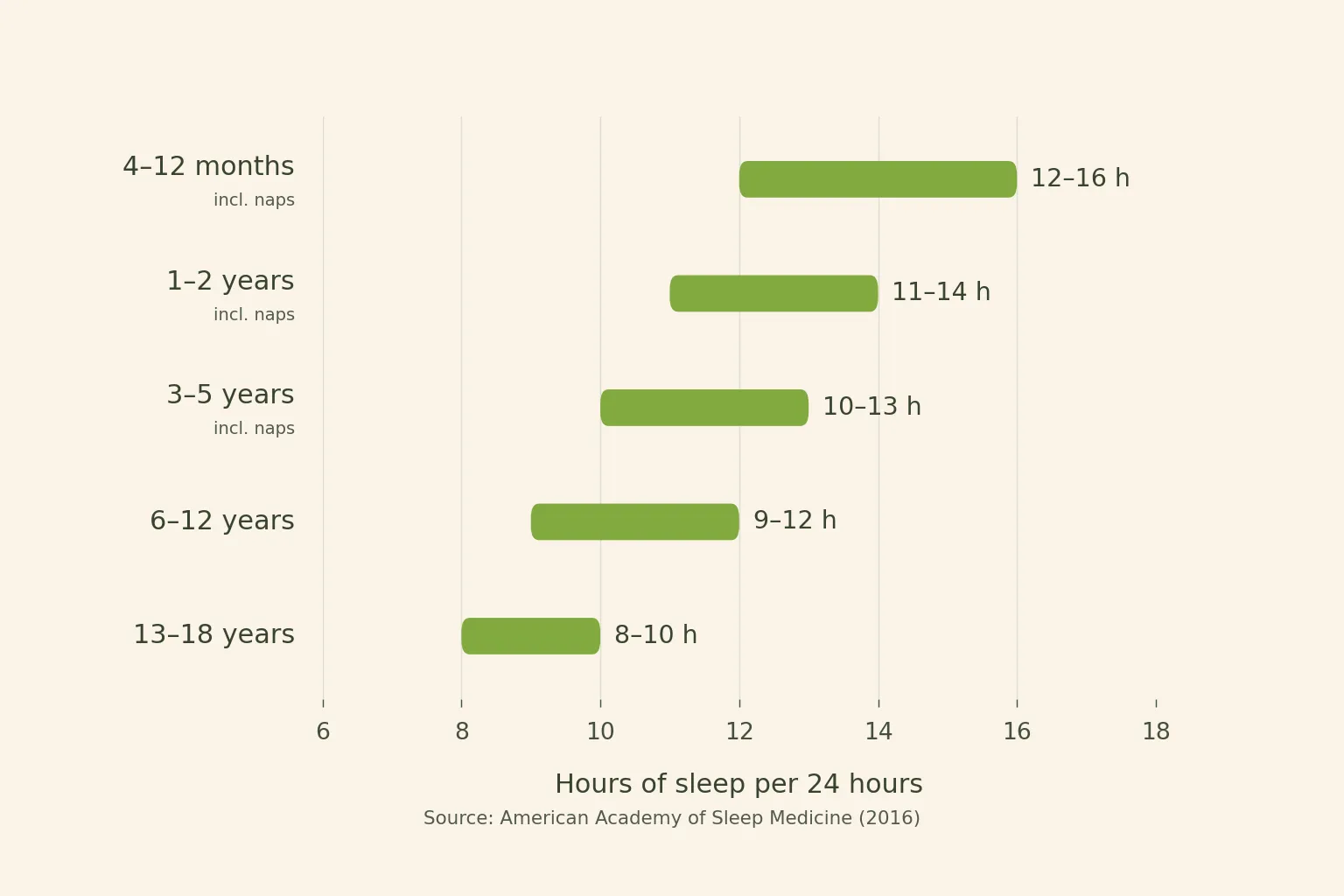
Sleep is the habit the others rest on. The American Academy of Sleep Medicine’s consensus statement on children’s sleep recommends these amounts in every 24 hours:
| Age | Recommended sleep |
|---|---|
| 4–12 months | 12–16 hours, including naps |
| 1–2 years | 11–14 hours, including naps |
| 3–5 years | 10–13 hours, including naps |
| 6–12 years | 9–12 hours |
| 13–18 years | 8–10 hours |
The panel linked regularly sleeping less than this with problems with attention, behaviour and learning, and with a higher risk of accidents, injuries, obesity and depression. These are expert recommendations rather than the result of a single study, and children vary, so treat them as a range, not a target to hit to the minute.
- Go to bed within the same half hour every night, weekends included.
- Get up at roughly the same time every day.
- Follow the same short bedtime routine: bath, pyjamas, teeth, story.
- Switch screens off an hour before bed.
- Keep phones and tablets out of the bedroom overnight.
- Get outside in daylight in the morning, even for ten minutes.
Healthy eating habits for kids
- Eat together as a family at least three times a week.
- Offer a vegetable at every evening meal, even one they usually leave.
- Let them help make one meal a week: washing, stirring, setting the table.
- Drink water with meals and keep a bottle filled during the day.
- Eat breakfast, even a small one.
- Keep a fruit bowl where they can reach it.
- Eat at the table, not in front of a screen.
- Try one new food a week: a single bite is enough.
Why family meals and “one more taste” work
In a meta-analysis of 17 studies covering more than 180,000 children and teenagers, Amber Hammons and Barbara Fiese found that those who shared family meals three or more times a week were more likely to be in a normal weight range and to eat healthily, and less likely to have disordered eating, than those who shared fewer. The studies were observational, so they show a link rather than proof that the meals cause it, but three meals a week is a modest, concrete goal.
Picky eating responds to patience. In a trial of 156 parents of 2 to 6 year olds, Jane Wardle and colleagues asked one group to offer their child a taste of a vegetable they disliked every day for 14 days. Those children liked and ate more of it afterwards; children whose parents got nutrition advice and a leaflet instead did not show the same gains. A small daily taste, without pressure, is a habit in its own right.
Active habits: moving and playing
The World Health Organization’s guidelines recommend that school-age children and teenagers get an average of 60 minutes a day of moderate to vigorous activity across the week, along with regular activities that strengthen muscles. They add that some activity is better than none. For younger children, the WHO’s guidance for under-5s suggests at least 180 minutes a day of any kind of activity from ages 1 to 4.
- Walk or scoot to school, or to the bus stop, when you can.
- Play outside after school before anything on a screen.
- Have one active weekend outing: a park, a swim, a bike ride.
- Dance to one song in the kitchen while dinner cooks.
- Do something that makes them out of breath, like running or skipping, most days.
- Climb, jump or hang from bars a few times a week, for strong muscles.
- Take a family walk after one dinner a week.
Hygiene habits: hands and teeth
The NHS advises brushing children’s teeth twice a day for about two minutes with fluoride toothpaste, one of them last thing at night. Use a smear of toothpaste up to age 3 and a pea-sized amount from 3 to 6, and teach children to spit, not rinse, so the fluoride keeps working. Parents brush until 3, supervise from 3 to 6, and most children can brush on their own from about 7.
For hands, the US Centers for Disease Control and Prevention’s handwashing steps are wet, lather, scrub for at least 20 seconds, rinse and dry. Humming “Happy Birthday” twice is about right.
- Brush teeth in the morning and last thing before bed.
- Spit out toothpaste after brushing, without rinsing.
- Wash hands after the toilet and before eating.
- Wash hands as soon as they come home.
- Cough or sneeze into an elbow.
- Put dirty clothes in the laundry basket every evening.
Screen time habits
The WHO recommends no sedentary screen time for 1 year olds and no more than an hour a day for 2 to 4 year olds, adding that less is better. For older children, the 2020 guidelines advise cutting down time spent sitting but found the evidence too thin to set a limit, so it’s often easier to build habits around when and where screens are used than to count minutes.
- No screens at the table.
- Screens off an hour before bed.
- Devices charge overnight outside the bedroom.
- Homework and play outside come before games and videos.
- Agree how long a session lasts before it starts, and set a timer.
Habits for feelings, kindness and focus
- Share one good thing and one hard thing from the day at dinner.
- Take three slow breaths when feelings get big.
- Name the feeling out loud: “I’m angry because…”.
- Say thank you to one person each day.
- Read together for 15 minutes before bed.
- Spend some time each day in free play, with nothing planned.
- Say “I can’t do it yet” instead of “I can’t do it”.
Habits that build independence
- Get dressed without help.
- Pack their own school bag the evening before.
- Make their bed every morning, however lumpy.
- Set the table for dinner.
- Tidy toys away before the next activity.
- Look after one plant or pet job every day.
How to teach kids healthy habits
Forty-five habits is a menu, not a plan. A child who is asked to change everything at once will change nothing. Start with three:
Then attach each one to something that already happens: “After bath time, we brush teeth,” or “When we get home, we wash hands.” Our guide on how to build a habit walks through the steps, and if you have older children, our list of good habits for students covers study and sleep at school age.
Expect it to take a while. In the best-known study of adult habit formation, a new daily habit took a median of 66 days to feel automatic, with a wide range between people (more in how long it takes to form a habit). That study was in adults, so treat it as a rough guide for children, but the lesson carries: think in months, not a week.
A sample day
Here’s what three habits look like in a real family day:
- 7:15 Breakfast at the table, water in a cup, then teeth.
- 16:00 Outside for an hour before anything on a screen.
- 19:15 Bath, pyjamas, teeth, one story, lights out by 19:45.
That’s not a new schedule, it’s the day you already have with a habit placed at each point.
Track healthy habits for kids on a chart
Children like seeing progress, and so do adults. A chart on the fridge with a box to tick each day is one of the simplest tools there is. Our free weekly habit tracker fits a family’s habits on one page, and a child can tick their own boxes.
There’s research behind the tick, too. In a meta-analysis of 138 studies, Benjamin Harkin and colleagues found that monitoring progress helped people reach their goals, and that the effect was larger when progress was physically recorded or shared with others. A chart on the fridge that the whole family can see does both.
For your own side of it, such as getting the family to the table three times a week or putting the phone away at bedtime, habitual is a habit tracker that keeps everything on your phone: no account and no ads. A habit can be counted (“3 family dinners”), timed with a built-in timer (“20 minutes reading together”), or something you’re quitting (“no phone at the table”), and the free version covers up to 3 active habits.
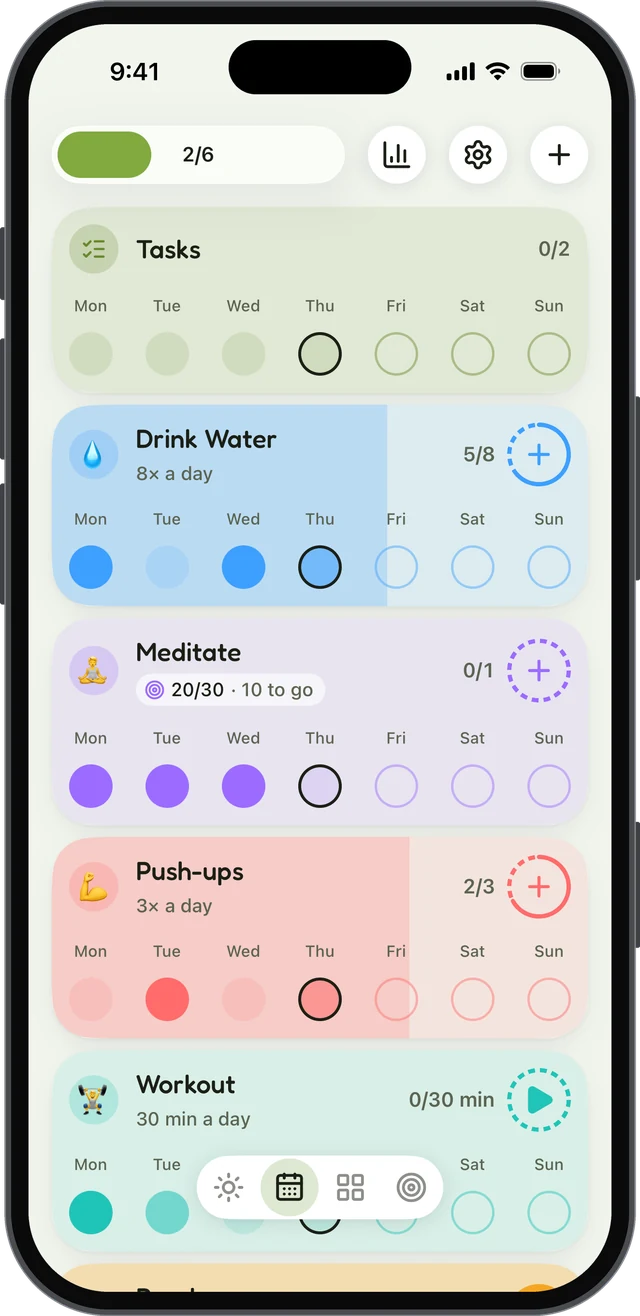
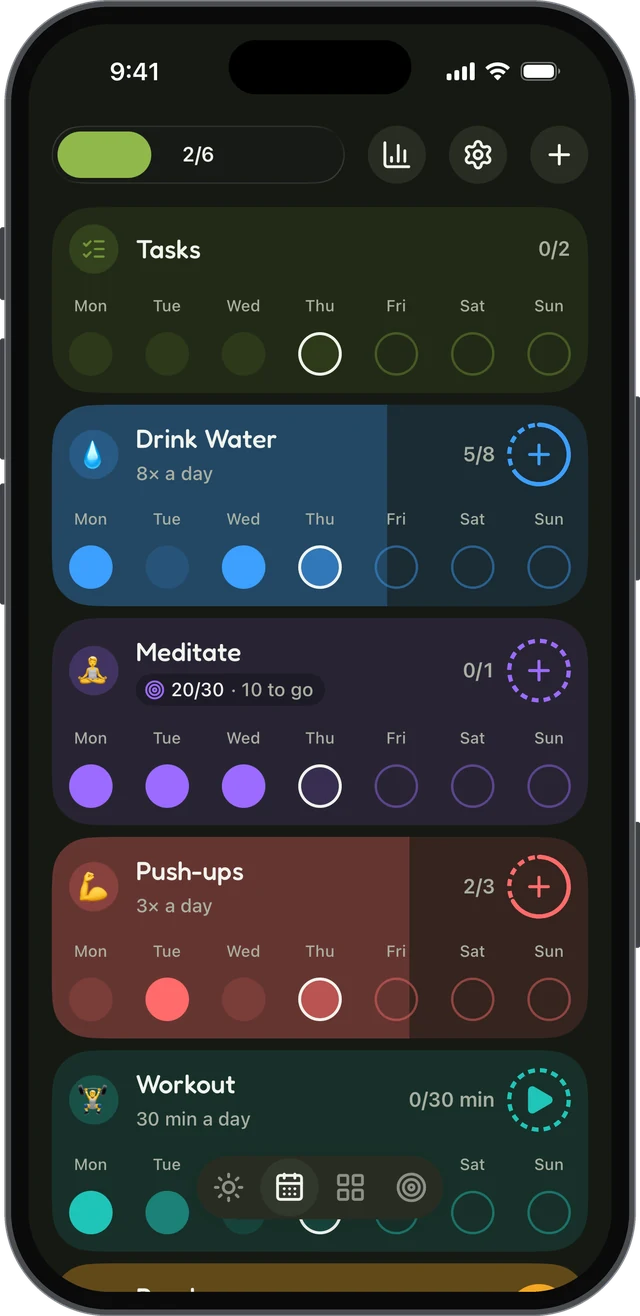
You can set a goal for the habit that matters most, such as 66 days of a regular bedtime. Goals in habitual only count up, so a missed night during a holiday or an illness never takes days away; it just moves the finish line a little. Family life will break any perfect streak, and that’s fine.
Sources
- Gardner, B., Lally, P., & Wardle, J. (2012). Making health habitual: The psychology of ‘habit-formation’ and general practice. British Journal of General Practice, 62(605), 664–666.
- Paruthi, S., Brooks, L. J., D’Ambrosio, C., Hall, W. A., Kotagal, S., Lloyd, R. M., Malow, B. A., Maski, K., Nichols, C., Quan, S. F., Rosen, C. L., Troester, M. M., & Wise, M. S. (2016). Recommended amount of sleep for pediatric populations: A consensus statement of the American Academy of Sleep Medicine. Journal of Clinical Sleep Medicine, 12(6), 785–786.
- Hammons, A. J., & Fiese, B. H. (2011). Is frequency of shared family meals related to the nutritional health of children and adolescents? Pediatrics, 127(6), e1565–e1574.
- Wardle, J., Cooke, L. J., Gibson, E. L., Sapochnik, M., Sheiham, A., & Lawson, M. (2003). Increasing children’s acceptance of vegetables: A randomized trial of parent-led exposure. Appetite, 40(2), 155–162.
- Bull, F. C., Al-Ansari, S. S., Biddle, S., Borodulin, K., Buman, M. P., Cardon, G., Carty, C., Chaput, J.-P., Chastin, S., Chou, R., Dempsey, P. C., DiPietro, L., Ekelund, U., Firth, J., Friedenreich, C. M., Garcia, L., Gichu, M., Jago, R., Katzmarzyk, P. T., … Willumsen, J. F. (2020). World Health Organization 2020 guidelines on physical activity and sedentary behaviour. British Journal of Sports Medicine, 54(24), 1451–1462.
- Harkin, B., Webb, T. L., Chang, B. P. I., Prestwich, A., Conner, M., Kellar, I., Benn, Y., & Sheeran, P. (2016). Does monitoring goal progress promote goal attainment? A meta-analysis of the experimental evidence. Psychological Bulletin, 142(2), 198–229.
Questions
At what age should you start teaching healthy habits?
As early as you like, starting with the ones you do for them. Parents brush a baby’s first teeth and set a regular bedtime long before a child can do either alone. From about 3 to 6, children can start doing parts of a habit themselves while you supervise, and by around 7 most can brush their own teeth.
How much sleep does a child need?
The American Academy of Sleep Medicine recommends 11 to 14 hours in 24 hours for 1 to 2 year olds and 10 to 13 hours for 3 to 5 year olds, both including naps. Children aged 6 to 12 need 9 to 12 hours, and teenagers 8 to 10. Regular bed and wake-up times matter as well as the total.
How much screen time should a child have?
The World Health Organization recommends no sedentary screen time for children under 2, and no more than an hour a day for 2 to 4 year olds, with less being better. For older children, the WHO’s 2020 guidelines advise cutting down time spent sitting but found too little evidence to set a number, so many families set screen-free times and places instead, such as meals and the hour before bed.
How do you get kids to stick to healthy habits?
Tie each habit to something that already happens every day, like brushing teeth straight after bath time, and keep the habit small. Do it with them, because children copy what they see. A simple chart they can tick also helps them see their progress.
Keep reading
- Ideas
Morning Routine Ideas: 40 Small Habits and How to Keep Them
40 morning routine ideas, grouped by what they do, plus 5-, 15- and 30-minute routines and what research says about making morning habits stick. - Ideas
Self-Care Habits: 50 Small Ideas and How to Make Them Stick
50 self-care habits for body, mind and the people around you, the research behind the ones that matter most, and how to choose three you’ll keep. - Ideas
Good Habits for Students: 40 Ideas Backed by Research
40 good habits for students, from study and sleep to phones and money, plus what research says works and how to start with just three.