
Ideas
Good Habits for Students: 40 Ideas Backed by Research
40 good habits for students, from study and sleep to phones and money, plus what research says works and how to start with just three.

Good habits for students aren’t about studying more hours. They’re about a handful of small, repeatable things: testing yourself instead of rereading, spreading study across the week, and sleeping at roughly the same time every night. Below are 40 ideas, grouped by area, with the research behind the ones that matter most.
You won’t need all 40. At the end there’s a simple way to choose your first three, and a sample week to show what that looks like. If you’re a parent of younger children, our list of healthy habits for kids covers the years before school and university.
What good habits for students have in common
A habit is something you do with little thought because a cue starts it: a time, a place, or something you already do. That’s good news for students, because your days already have a timetable full of cues. The end of a lecture, the walk home and the first coffee of the morning are all ready-made triggers.
The best student habits share three things:
- They’re small. “Review today’s notes for 10 minutes” beats “study more”.
- They’re specific. You can tell at the end of the day whether you did it.
- They’re tied to a cue. “After my last class, I’ll…” gives the habit somewhere to live.
Keep those three tests in mind as you read the list.
Good study habits
These are the habits with the strongest evidence behind them. A large review of ten learning techniques by John Dunlosky and colleagues rated two as highly useful for learners of different ages and abilities, across many kinds of test: practice testing and distributed practice (spreading study out over time). Rereading and highlighting, the methods most students report using, were rated low.
- Test yourself on today’s material for 10 minutes. Flashcards, past papers, or closing the book and writing down what you remember.
- Review each lecture’s notes within 24 hours.
- Spread each subject over at least three short sessions a week instead of one long one.
- Before you reread a chapter, try to answer its end-of-chapter questions first.
- Explain one idea a day out loud, as if teaching a friend.
- Mix different kinds of problems in one practice session instead of doing them in blocks.
- Start each assignment on the day you get it, even if only for 15 minutes.
- Write tomorrow’s study plan before you finish today.
- Keep one list of everything due, and look at it every morning.
- Ask one question in every class or seminar.
Why spacing beats cramming
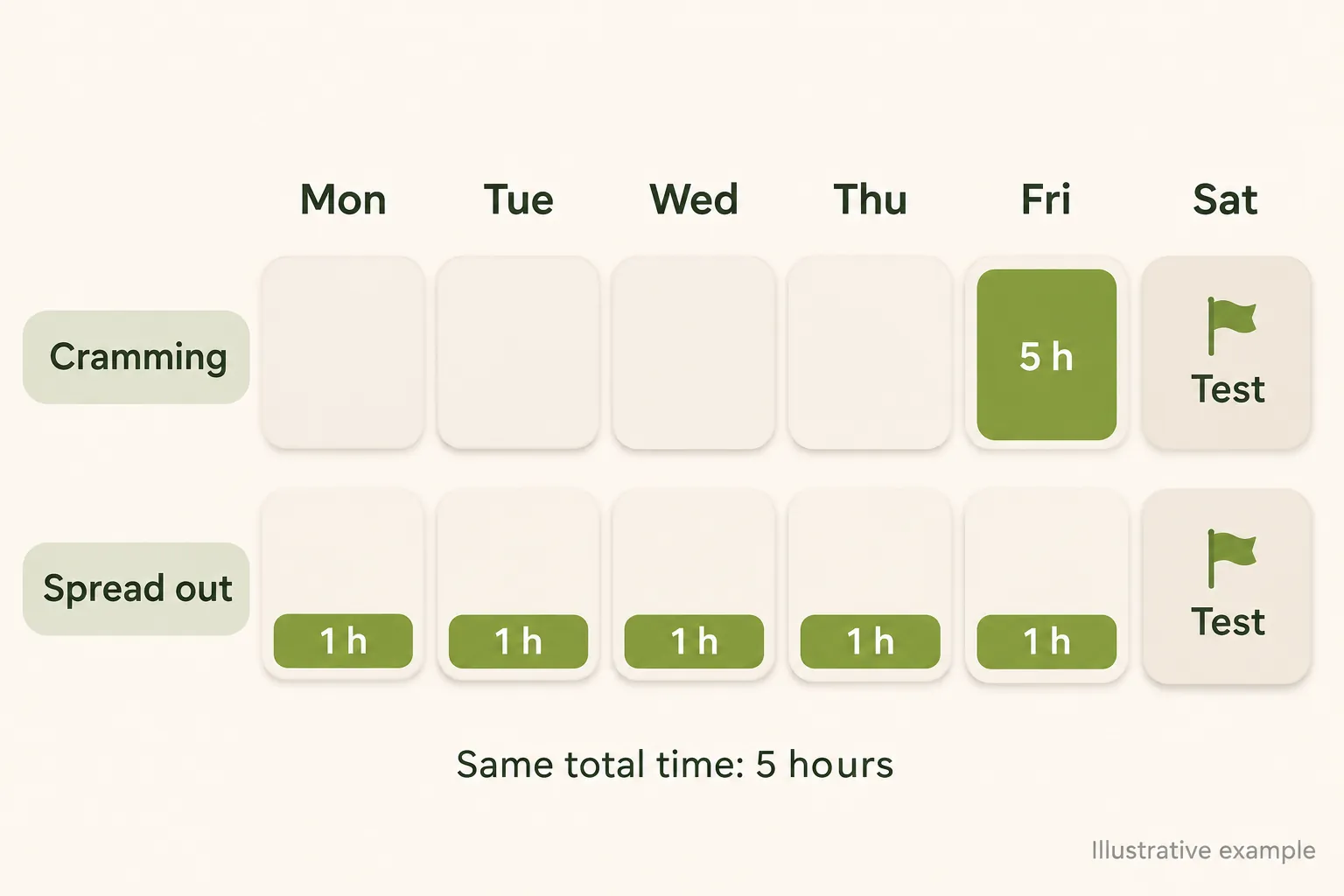
A review of 317 experiments by Nicholas Cepeda and colleagues found that spacing study sessions apart improved how much people remembered later, and that the best gap between sessions grew the further away the test was. In practice: the further away the exam, the more widely you can spread your sessions, so start early and come back to each topic several times.
Plan when you study, not just what
When Marissa Hartwig and John Dunlosky surveyed 324 undergraduates about their study habits, self-testing went with higher grades (so, perhaps surprisingly, did rereading). Scheduling mattered too: lower performers were more likely to study late at night, and all students, especially the lower performers, said their studying was driven by upcoming deadlines. It was a survey, so it shows a link rather than a cause, but it fits the research above.
Healthy habits for students
- Go to bed within the same hour every night, weekends included.
- Get up at roughly the same time every day.
- No screens in bed.
- Drink a glass of water when you get up.
- Eat breakfast, even a small one.
- Walk or move for 20 minutes a day.
- Get outside in daylight before midday.
- Cook one meal a week instead of ordering in.
- Stretch for 5 minutes after a long study block.
- Keep caffeine to the morning and early afternoon.
Sleep is a study habit
In a study of 88 students in an introductory chemistry class, researchers measured sleep with wearable activity trackers and compared it with quiz and exam results. Better quality, longer and more consistent sleep went with better grades, and sleep measures accounted for nearly a quarter of the differences in performance. Sleep on the single night before a test showed no link with the score; what counted was sleep over the week and the month before. It was one class and it shows a link, not proof of cause, but the message is clear: a regular bedtime does more than an all-nighter. Our guide to habits for better sleep covers the everyday habits that make regular sleep easier.
Focus and phone habits
- Phone in another room, or at least out of reach, while you study.
- Work in blocks of 25 to 50 minutes with a short break after each.
- Turn off notifications for everything except calls and messages from people.
- No social media before your first study block of the day.
- Use the same place for focused work every day.
- Clear your desk at the end of the day.
- Close every tab you don’t need before you start.
Organisation and money habits
- Check your calendar and deadlines every Sunday evening.
- Break every big assignment into steps with their own dates.
- Back up your work at the end of each day.
- Write down what you spend each day.
- Have one no-spend day a week.
- Pack lunch two days a week.
Wellbeing and social habits
- Message one friend or family member a day.
- Write three lines in a journal before bed.
- Write down one thing that went well today.
- Spend 15 minutes on something that isn’t study or work.
- Go to one society, club or team session a week.
- Breathe slowly for 2 minutes before an exam or a hard task.
- Take one full evening a week off.
For more ideas outside student life, see our list of 60 habits to track. If you’re running on empty, our list of self-care habits has 50 small ways to look after yourself.
Bad habits for students, and what to do instead
Many good habits are easiest to build as a swap. Track the new one as something you do, or track the old one as something you’re quitting, counting the days you stayed on track.
| Bad habit | Swap it for |
|---|---|
| Cramming the night before | Three short sessions spread over the week |
| Rereading and highlighting | Ten minutes of testing yourself |
| Studying late into the night | A fixed bedtime and an earlier study block |
| Phone on the desk | Phone in another room while you study |
| Starting when the deadline is close | Fifteen minutes on the day you get the assignment |
How to choose your first three
Forty habits is a menu, not a plan. A term is busy, and a habit you drop in week three teaches you nothing. Start with three:
Then make each one concrete with an if-then plan: “After my last class, I’ll test myself on today’s notes for 10 minutes.” In a review of 94 studies, Peter Gollwitzer and Paschal Sheeran found that plans in this form had a medium-to-large effect on whether people followed through. Our guide on how to build a habit walks through the rest of the steps.
Give it time, too. In the best-known study of habit formation, a new daily habit took a median of 66 days to feel automatic, with a range from 18 to 254 (more in how long it takes to form a habit). That’s most of a term, so start in the first week rather than the week before exams.
A sample week
Here’s what three habits look like in a real timetable:
- Test yourself for 10 minutes, after your last class, Monday to Friday.
- In bed by 11:30, every night, with the phone charging across the room.
- A 20-minute walk, after lunch, five days a week.
That’s about 30 minutes a day, and none of it needs willpower once the cues are set.
Track it so you can see it
Writing down what you did is a habit in itself, and a useful one: it shows you which days you skip and which habit needs a better cue. A sheet of paper is enough. Our free weekly habit tracker fits a student’s week on one page.
If you’d rather use your phone, habitual is a habit tracker that keeps everything on the phone itself: no account, no ads, and its free version covers up to 3 active habits, which is exactly the number we’d suggest starting with. A habit can be counted (“3 study sessions”), timed with a built-in timer (“25 minutes of focused work”), or something you’re quitting (“no phone in bed”).
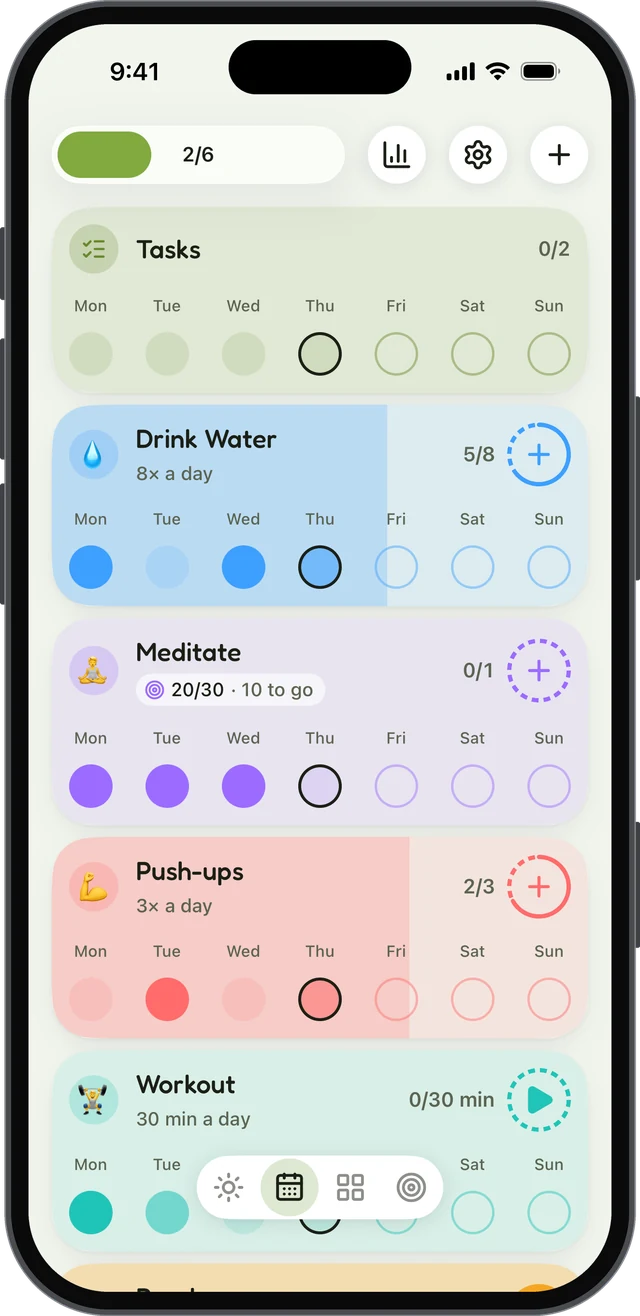
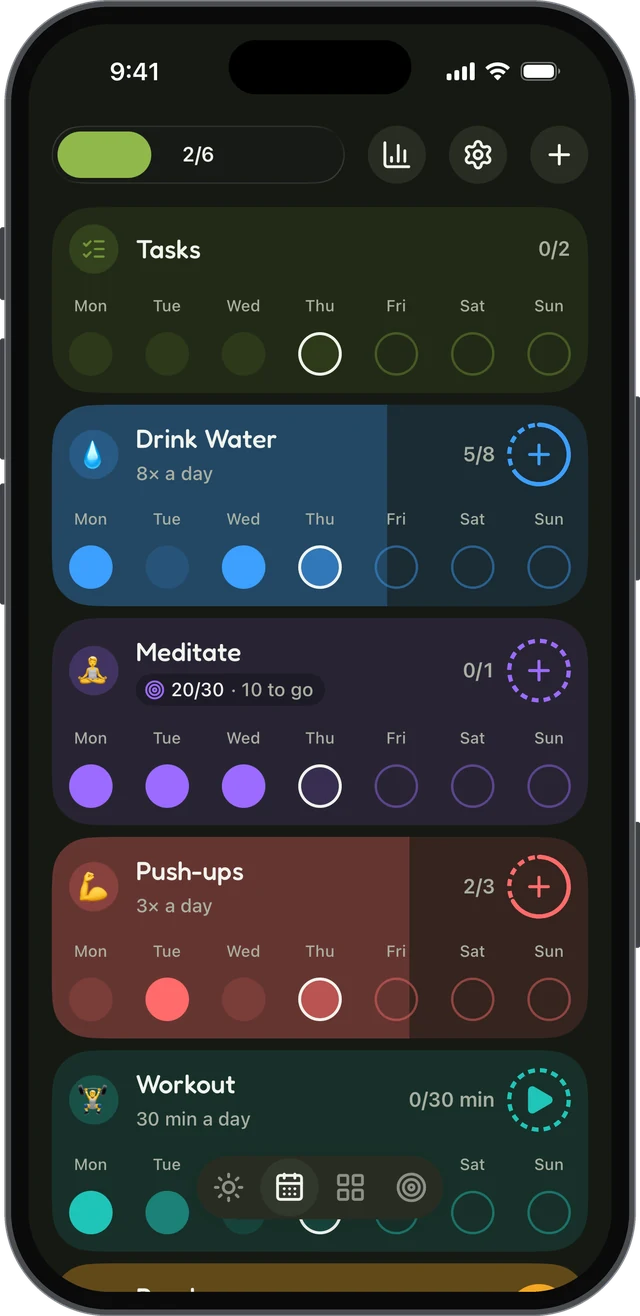
You can also set a goal of, say, 66 days for the habit that matters most. In habitual, goals only count up: a missed day never takes days away, it just moves the finish line a little. That suits a student’s calendar, where exam weeks and trips home will break any perfect streak. If that happens, read what to do after a missed day and carry on.
Sources
- Cepeda, N. J., Pashler, H., Vul, E., Wixted, J. T., & Rohrer, D. (2006). Distributed practice in verbal recall tasks: A review and quantitative synthesis. Psychological Bulletin, 132(3), 354–380.
- Dunlosky, J., Rawson, K. A., Marsh, E. J., Nathan, M. J., & Willingham, D. T. (2013). Improving students’ learning with effective learning techniques: Promising directions from cognitive and educational psychology. Psychological Science in the Public Interest, 14(1), 4–58.
- Gollwitzer, P. M., & Sheeran, P. (2006). Implementation intentions and goal achievement: A meta-analysis of effects and processes. Advances in Experimental Social Psychology, 38, 69–119.
- Hartwig, M. K., & Dunlosky, J. (2012). Study strategies of college students: Are self-testing and scheduling related to achievement? Psychonomic Bulletin & Review, 19(1), 126–134.
- Lally, P., van Jaarsveld, C. H. M., Potts, H. W. W., & Wardle, J. (2010). How are habits formed: Modelling habit formation in the real world. European Journal of Social Psychology, 40(6), 998–1009.
- Okano, K., Kaczmarzyk, J. R., Dave, N., Gabrieli, J. D. E., & Grossman, J. C. (2019). Sleep quality, duration, and consistency are associated with better academic performance in college students. npj Science of Learning, 4, 16.
Questions
What are 10 good habits for students?
Ten good ones to start with: test yourself instead of rereading, spread study over several days, plan tomorrow’s study tonight, go to bed at the same time each night, keep your phone out of reach while you study, start assignments the day you get them, review your notes within 24 hours, move for 20 minutes a day, eat breakfast, and ask one question in every class. Pick one to three, not all ten.
What is the most important study habit?
If you only change one thing, test yourself. A large review of ten learning techniques rated practice testing and spreading study out over time as the two most useful, while rereading and highlighting, the methods students use most, were rated low.
How many habits should a student work on at once?
One to three. Each new habit takes around two months to feel automatic, and a term already asks a lot of you. Add another only when the first ones happen without much thought.
What are bad habits for students?
The common ones are cramming the night before, studying late into the night, rereading notes instead of testing yourself, keeping your phone on the desk, and starting work only when the deadline is close. Each one has a simple replacement habit you can track.
Keep reading
- Ideas
Morning Routine Ideas: 40 Small Habits and How to Keep Them
40 morning routine ideas, grouped by what they do, plus 5-, 15- and 30-minute routines and what research says about making morning habits stick. - Ideas
Healthy Habits for Kids: 45 Ideas and How to Make Them Stick
45 healthy habits for kids, grouped by sleep, food, play, teeth, screens and feelings, with the guidelines behind them and how to make them stick. - Ideas
Self-Care Habits: 50 Small Ideas and How to Make Them Stick
50 self-care habits for body, mind and the people around you, the research behind the ones that matter most, and how to choose three you’ll keep.